

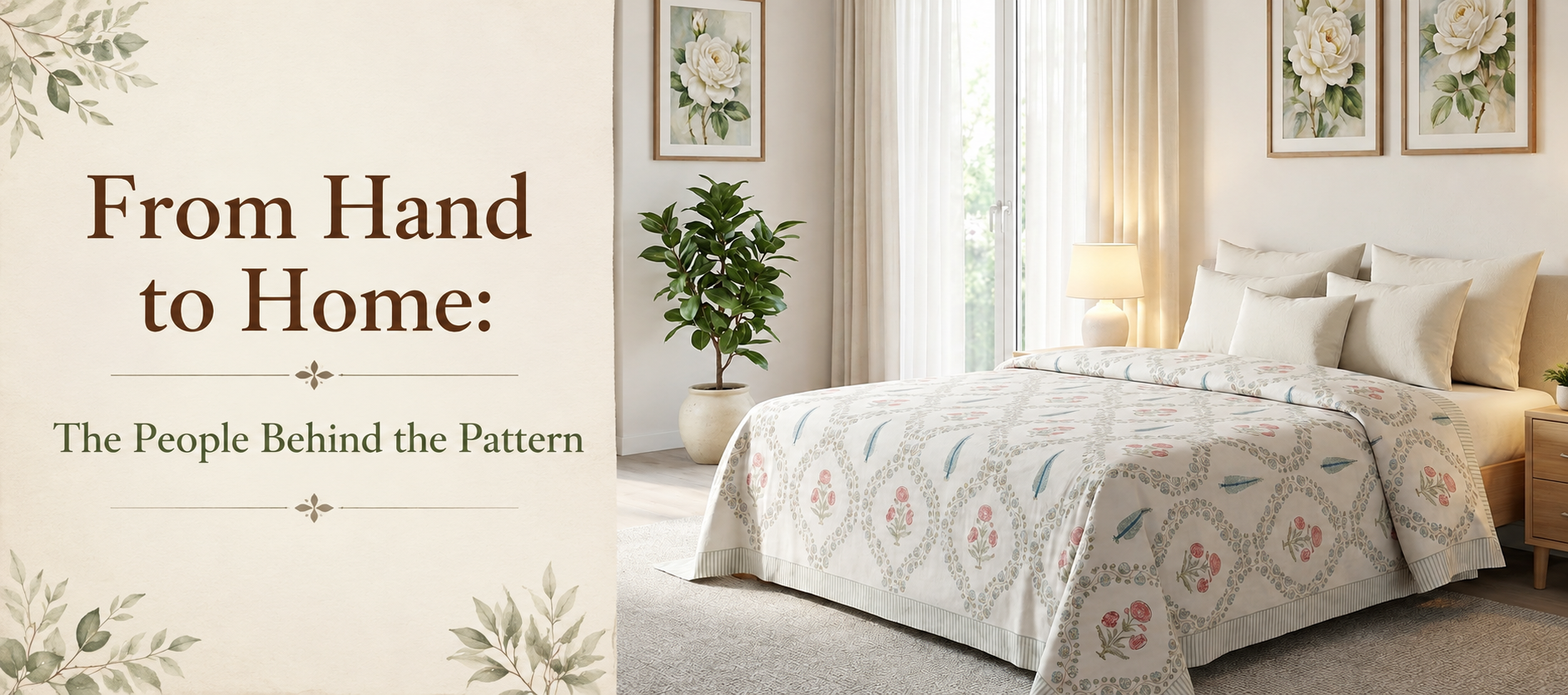
From Hand to Home: The People Behind the Pattern
Every printed cotton quilt or bedspread has a maker behind it, though it's easy to forget that when a product arrives folded and ready to use. Traditional block printing India has practised for centuries still relies on the same combination of hand-carved wood, natural dye and human patience, and understanding that process changes how a printed textile feels once it's on your bed. This is a look at the people, tools and stages behind every pattern, from the carver's workshop to the finished quilt.
What Is Traditional Block Printing?
Traditional block printing is a hand textile technique in which a carved wooden block is dipped in dye and pressed onto fabric by hand, repeated across the cloth to build a continuous pattern. Practised in India for centuries, particularly in Rajasthan and Gujarat, it produces textiles with slight, natural variation that no mechanical printing process replicates.
The Craft Behind Traditional Block Printing in India
Traditional block printing in India is a multi-stage craft that begins long before any fabric is touched, starting instead with the carving of the wooden block itself. Each stage of the process depends on skills passed down through families and craft communities, rather than standardised industrial machinery.
The Carver
A block carver, often trained from childhood within a family workshop, spends anywhere from a few hours to several days carving a single design into a block of seasoned teak, sheesham or mango wood, cut roughly 5-7 cm thick to resist warping under repeated pressing. Fine floral or paisley motifs, the kind found across much of Rajasthan's textile tradition, can take a skilled carver up to a week to complete, since each groove and curve is cut entirely by hand with small chisels, and a separate block is carved for every colour in a multi-colour design.
The Dyer
Before printing begins, raw cotton is soaked in water for one to two days to loosen its natural starch, then beaten by hand against stone to soften the fibres before being left to dry and bleach naturally in the sun — a preparation stage that predates any synthetic finishing process. Natural and fibre-reactive dyes are then mixed in small batches, often by eye and experience rather than fixed measurement, which is part of why colour can vary subtly between production runs — a mark of handwork rather than an inconsistency.
The Printer
The printer works at a long table, dipping the carved block into a dye tray and pressing it onto stretched fabric in a repeating grid, judging alignment by eye with each stamp. A skilled printer can place a block accurately hundreds of times across one length of cloth, and the slight shifts in that repetition are what give hand-printed fabric its distinctive texture compared with machine-printed cloth.
The Finisher
Once printing is complete, the fabric dries and cures before final washing, which sets the dye and softens the cloth. For quilted pieces, this stage also includes hand-quilting, where a separate set of artisans stitch layers of cotton together, often using the same running-stitch technique found in Kantha work.
Where This Craft Comes From
Jaipur and the surrounding Sanganer and Bagru clusters in Rajasthan are among India's most recognised centres for hand block printing, historically practised by the Chippa community of dyers and printers. Bagru printing specifically has been documented in the region for more than 400 years, with the carving, dyeing and printing skills typically passed down within families rather than taught formally. Sanganeri prints are known for fine, detailed floral motifs on a light background, while Bagru printing favours earthier tones like indigo, madder red and ochre, produced using traditional resist and mud-dyeing methods that predate synthetic colourants.
These distinctions matter beyond aesthetics. A Sanganeri-style pattern on a bedspread signals a different regional technique and dye tradition than a Bagru-style one, even though both fall under the same broad umbrella of hand block printing. Gujarat's Ajrakh tradition, by comparison, uses a slower resist-and-indigo process that can involve well over a dozen dyeing steps for a single length of cloth — a useful reminder that "block printing" covers a wide range of techniques rather than one single process.
Why Hand-Printed Textiles Cost More Than Machine-Printed Ones
Hand block-printed fabric costs more than machine-printed equivalents because of the labour hours involved at every stage, not the raw material itself. A single quilt-sized length of fabric can involve a carver, a dyer, a printer and a finisher, each contributing skilled manual work that a printing press completes in seconds:
- Block carving: Days of manual carving per design, versus an engraved roller produced once and reused indefinitely by machines.
- Dye mixing: Small hand-mixed batches, adjusted by experience, rather than automated colour-matching.
- Printing: Each repeat stamped individually by a person, versus continuous rotary printing at industrial speed.
- Finishing: Hand-quilting and stitching where relevant, versus machine-stitched seams.
The result is a textile where minor irregularities in the print — a slightly uneven repeat, a subtle colour shift — are evidence of the process rather than a flaw in it.
How to Tell Hand Block Print From a Machine Print
The clearest sign of genuine hand block printing is a slight irregularity in the repeat: look closely and you'll usually find small variations in spacing or alignment that a machine print, produced from a single continuous roller, would never show. Hand-printed fabric also tends to show dye sitting slightly on the surface of the weave rather than being perfectly uniform, a texture you can often feel as well as see.
From Fabric to Finished Textile
Once printed and cured, cotton fabric moves into finishing, becoming the quilts, bedspreads and dohars found in a bedroom rather than a length of cloth on a workshop table. The same hand-block printed cotton can be layered into a lightweight dohar for summer or a filled, quilted piece for colder months.
Indian Quilts Built to UK Bed Sizing
Once cut and filled, hand-printed cotton follows standard UK bed dimensions rather than one universal size. Shoppers exploring indian quilts will typically find options from single beds through to larger doubles, each carrying the same hand-block printed cotton and cotton-batting fill regardless of size.
Twin Size Quilts for Single Beds and Children's Rooms
A single bed calls for a quilt cut close enough to avoid excess overhang. A twin size quilts collection typically suits a single bed at around 150 x 200 cm — a practical choice for guest rooms and children's bedrooms alike.
King Size Quilts for Larger Mattresses
Larger beds need proportionally more fabric and a wider hand-printed repeat to avoid the pattern looking stretched. A king size quilts range is cut generously enough to cover larger mattresses with a full drape on either side.
Cotton Queen Bedspread for Lighter, Everyday Layering
Not every bedroom needs the weight of a filled quilt, particularly through warmer months. A cotton queen bedspread offers a lighter alternative — a flat layer of printed cotton rather than a quilted, filled piece.
Block Print Bedspread as a Decorative Finish
Where a quilt is built primarily for warmth, a bedspread is built primarily for appearance. A printed block print bedspread brings the same hand-carved pattern language onto a flatter, more decorative textile.
Cotton Percale Bedding for a Crisp, Breathable Feel
Cotton percale bedding is prized for its crisp, matte-finish weave, which holds a printed pattern especially well while remaining breathable through UK seasons — cooler against the skin than a standard cotton weave.
Caring for Hand Block-Printed Textiles
Hand block-printed cotton generally responds best to gentle care: cold water washing, a mild detergent, and air-drying rather than high-heat tumble drying. These steps preserve both the natural dye colour and the slight surface texture that comes from hand-printing, and most pieces soften rather than wear thin with repeated washing when cared for this way.
What This Means for the People Who Make It
Buying a hand-printed textile supports a specific chain of skilled work — a carver, a dyer, a printer, a finisher — rather than a single automated process. This work sustains entire craft communities in Rajasthan where the skills are typically passed down within families over generations rather than taught through formal industrial training. Choosing hand-printed cotton over a machine-printed equivalent is, in a fairly direct sense, a choice about who gets paid for the work and how that skill continues to be practised — a single artisan can only carve, dye or print so much fabric in a day, which naturally limits output in a way mass manufacturing doesn't.
In Short
A hand block-printed quilt or bedspread carries the work of several skilled artisans, each responsible for one stage of a process that has changed very little in centuries. Traditional block printing India relies on carved wooden blocks, small-batch natural dyes and manual precision, which is why every piece carries small, genuine variations rather than perfect uniformity. Understanding this process is, in many ways, the clearest way to understand what you're actually paying for when you choose handcrafted textiles over mass-produced ones.
Frequently Asked Questions
What is traditional block printing and how is it done?
Traditional block printing is a hand textile technique where a carved wooden block is dipped in dye and pressed onto fabric by hand, repeated across the cloth to build a pattern. It has been practised in India for centuries, particularly in Rajasthan, using techniques passed down through generations of artisan families.
How long does it take to make one hand block-printed piece?
Timelines vary by design complexity, but a single intricate block can take a carver several days to complete, and printing a full length of fabric can take an additional day or more depending on the pattern's detail. Finishing steps like hand-quilting add further time before a piece is ready.
Why does hand block-printed fabric have slight variations?
Every stamp of the block is placed by hand, so small shifts in spacing, pressure and alignment naturally occur across a length of fabric. These variations are considered a mark of authentic handwork rather than a defect, distinguishing hand-printed textiles from perfectly uniform machine prints.
What is the difference between Sanganeri and Bagru block printing?
Sanganeri printing, from the Sanganer cluster near Jaipur, typically features fine floral motifs on light backgrounds. Bagru printing uses earthier natural dyes like indigo and madder red, often combined with traditional resist and mud-dyeing methods, producing a more rustic, grounded colour palette.
How should I wash a hand block-printed cotton quilt or bedspread?
Wash in cold water with a mild detergent, avoid bleach, and air-dry rather than tumble-dry on high heat. This routine protects the natural dye colour and the slight surface texture created during hand-printing, helping the piece soften over time rather than wear out.
-
 September 25th, 2026
 -
 September 18th, 2026
 -

The Art of Layering Textiles: How UK Homes Can Mix Quilts & Tablecloths
September 11th, 2026 -

Duvet vs Quilt vs Bedspread: What's the Difference and Which One Do You Need?
September 11th, 2026 -
 August 26th, 2026