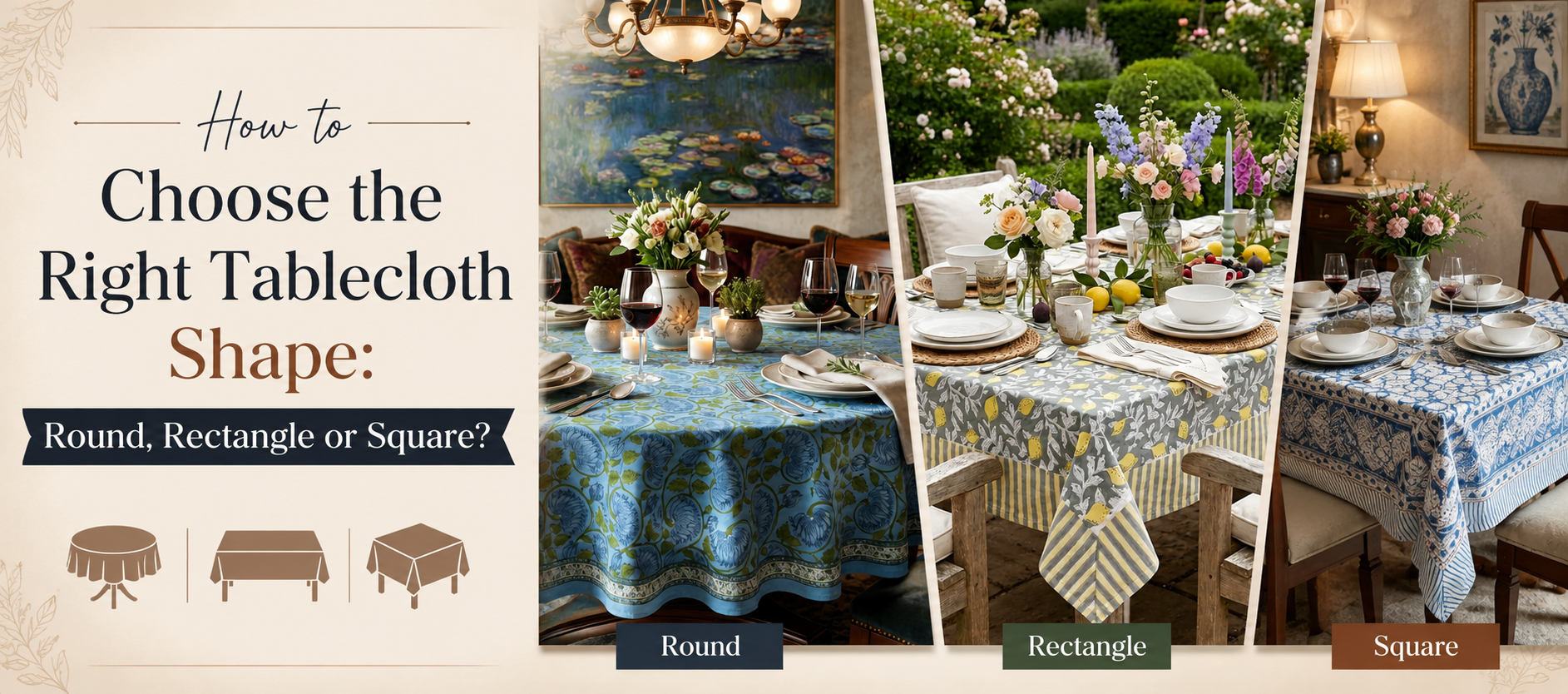
How to Choose the Right Tablecloth Shape: Round, Rectangle or Square?
Choosing a tablecloth sounds simple until you're standing in front of a dining table wondering whether a round cloth will actually sit right on a rectangular surface. Shape matters as much as size — a cloth cut for the wrong table shape will bunch at the corners, hang unevenly, or leave awkward gaps. This guide walks through how to pick the right size tablecloth for round, rectangle and square tables, so the fabric you buy actually fits the table you own.
What Determines the Right Tablecloth Shape?
The right tablecloth shape always matches the shape of the tabletop itself: round cloths for round or oval tables, rectangular cloths for rectangular or oblong tables, and square cloths for square tables. Getting the shape right first, then the size, prevents the most common fitting problems — puddling fabric at the corners of a round cloth on a square table, or a rectangular cloth that trails unevenly off a round one.
In short: a tablecloth's shape should mirror the tabletop's outline, while its size should add roughly 20–45 cm of overhang on every side beyond the table's edge for a proportionate, elegant drape.
Round Tablecloths: Which Tables Do They Suit?
Round tablecloths are designed for circular and oval dining and occasional tables, and they work best when the diameter of the cloth clears the table's edge evenly on all sides. They're a natural fit for bistro tables, breakfast nooks, and round dining sets seating four to ten people.
Sizing a Round Table Cover Cloth
To size a round table cover cloth correctly, measure the table's diameter edge to edge, then add 30–45 cm for a graceful overhang that reaches partway down the table legs without pooling on the floor. A 150 cm cloth typically suits a four-seater round table, while 220 cm and above works better for larger eight-to-ten seater settings.
Choosing Round Table Covers for Everyday Use
For everyday dining rather than formal occasions, many households prefer a shorter overhang of around 20–25 cm, which keeps round table covers from catching on chairs or laps when guests sit down. Hand block-printed cotton in this format also tends to sit flatter than synthetic blends, since natural cotton has enough weight to hold its shape without stiffening agents.
Rectangle Tablecloths: Best For Which Tables?
Rectangle tablecloths are the standard choice for most family dining tables in the UK, since the majority of dining sets are rectangular rather than round or square. They also suit long console or sideboard surfaces where a neat, symmetrical drape matters.
Getting the Length and Width Right
A typical UK four-to-six seater table measures around 90 x 180 cm, and a 150 x 220 cm rectangle tablecloths cloth gives roughly 20–30 cm of overhang on each side — enough to look considered without draping into laps. Wider eight-to-twelve seater tables generally call for cloths starting at 180 x 300 cm and moving up to 180 x 340 cm for the longest banquet-style setups.
As with any natural cotton textile, expect a small amount of shrinkage — usually 3–5% — after the first wash, which most UK sellers already account for in their stated dimensions.
Square Tablecloths: When They're the Right Choice
Square tablecloths suit square dining tables and smaller bistro or occasional tables, most commonly in four-seater settings. A 150 x 150 cm cloth is a reliable starting point for a standard 90 x 90 cm square table, giving an even overhang on all four sides.
Square cloths also work well layered over a round or rectangular base cloth for a two-tone table setting — a styling technique that adds visual depth without needing extra linens beyond what's already in a typical UK home.
Measuring for a Perfect Fit: A Step-by-Step Method
Knowing how to pick the right size tablecloth comes down to three measurements: the table's shape, its exact dimensions, and how much overhang is wanted. Follow this sequence for a reliable fit every time.
- Identify the table shape — round, rectangle, oval or square — since this determines the cloth shape, not just its size.
- Measure the tabletop — diameter for round tables, length and width for rectangular or square tables — using a tape measure rather than estimating by eye.
- Decide on overhang — 15–20 cm for a casual, everyday look; 25–35 cm for dinner parties; 40 cm or more for a formal, floor-grazing finish.
- Add the overhang to each dimension — for a rectangle table, add the chosen overhang to both length and width; for round tables, double the overhang and add it to the diameter.
- Account for shrinkage on natural fabrics — allow a few extra centimetres if buying 100% cotton, since it will settle slightly smaller after laundering.
Long Tablecloths for Extended and Banquet-Style Tables
Extended dining tables, banquet setups, and tables pushed together for larger gatherings all call for a longer format than a standard rectangular cloth.
Why Long Tablecloths Suit Bigger Gatherings
long tablecloths in the 180 x 300 cm to 180 x 340 cm range are built for ten-to-twelve seater tables, extended leaf tables, and event-style dining, where a shorter cloth would leave the ends of the table exposed. Measuring the full extended length — not just the table's folded-down size — avoids ordering a cloth that falls short once extra leaves are added.
Fabric and Craftsmanship: Why Material Affects Fit
Shape and size aren't the only factors that determine how a tablecloth sits on a table — the fabric itself plays a real role in drape, structure, and how well the cloth holds its intended dimensions over time.
What Block Print Cotton Tablecloth Fabric Adds
A block print cotton tablecloth is made from single-weave, breathable cotton that sits flat without needing starch or stiffening agents, which helps it drape evenly along every edge rather than curling or clinging. Each design is hand-carved into a wooden block and stamped onto the fabric by artisans in Jaipur and Sanganer, Rajasthan — a technique practised in the region for centuries and still largely unchanged in method today.
Sourcing Indian Tablecloths Online
Buyers researching indian tablecloths online are often looking for genuine hand-block printing rather than machine-printed imitations, and the two are usually easy to tell apart: hand-printed cloths carry small, natural variations in ink coverage and pattern alignment that machine printing doesn't replicate. That irregularity is a sign of authentic craftsmanship rather than a flaw.
Round vs Rectangle vs Square: A Quick Comparison
Comparing the three shapes side by side makes it easier to match a cloth to a table at a glance.
- Round: best for circular and oval tables; typical sizes run from 150 cm (four-seater) to 275 cm (ten-seater); overhang of 30–45 cm gives the most elegant finish.
- Rectangle: best for standard UK dining tables; sizes typically start at 150 x 220 cm and extend to 180 x 340 cm; overhang of 20–30 cm suits most households.
- Square: best for square four-seater and bistro tables; 150 x 150 cm is the most common starting size; works well layered with a contrasting cloth underneath.
Common Mistakes to Avoid When Choosing a Tablecloth
A few recurring errors account for most ill-fitting tablecloths, and each one is easy to avoid once flagged.
Measuring the table's visible surface without accounting for an extending leaf is one of the most frequent mistakes, since the cloth then falls short the moment the table is extended for guests. Buying by "seats" rather than actual centimetres is another — seating capacity varies by chair spacing, so a stated measurement is always more reliable than a seat count alone. Finally, ignoring fabric shrinkage on natural cotton cloths can leave a cloth 3–5% smaller than expected after the first wash, which is why allowing a small buffer at purchase matters.
It also helps to measure with the table in its everyday position, including any leaves that are usually kept in place, rather than measuring a bare tabletop in a showroom or catalogue photo. Chairs pulled in at mealtimes reduce the effective overhang that's comfortable to sit with, so a slightly shorter drape often suits a busy family table better than a formal floor-length one. Keeping a written note of the exact measurements — length, width or diameter, plus preferred overhang — makes reordering or replacing a cloth far quicker the next time round.
Frequently Asked Questions
How do I know what shape tablecloth to buy?
Match the cloth shape to the tabletop shape: round for circular or oval tables, rectangular for oblong tables, and square for square tables. Buying a shape that doesn't match the tabletop causes uneven overhang, bunching at corners, or gaps along the edges.
How much overhang should a tablecloth have?
Most UK dining tables look best with 20–30 cm of overhang on each side for everyday use, or 35–45 cm for a more formal, floor-length finish. Shorter overhangs of 15–20 cm work well for casual family meals where fabric shouldn't sit in laps.
What size tablecloth do I need for a 6-seater table?
A rectangular six-seater table, typically around 90 x 180 cm, generally needs a cloth close to 150 x 220 cm for a comfortable drape. A round six-seater table, around 150–180 cm in diameter, usually pairs with a 180–220 cm round cloth.
Do hand block-printed cotton tablecloths shrink after washing?
Yes, natural cotton typically shrinks by around 3–5% after its first wash, which is worth factoring in when choosing a size. Washing a new cotton tablecloth once before first use helps it settle to its final dimensions ahead of everyday wear.
Can I use a round tablecloth on a rectangular table?
A round tablecloth on a rectangular table will leave the corners uncovered and the sides too short, so it isn't a reliable substitute. Matching cloth shape to table shape remains the most dependable way to get an even, well-proportioned drape.
In Short: Choosing the right tablecloth ultimately comes down to matching shape to tabletop, measuring accurately rather than estimating, and allowing for the natural characteristics of the fabric itself. Round, rectangle and square cloths each suit specific table types, and getting the sizing right — with the correct overhang and a small allowance for shrinkage — is what determines whether a cloth looks tailored or ill-fitting. A well-chosen, hand block-printed cotton tablecloth, sized correctly for its table, remains one of the simplest ways to change the character of a dining space.
-
 September 18th, 2026
 -

The Art of Layering Textiles: How UK Homes Can Mix Quilts & Tablecloths
September 11th, 2026 -

Duvet vs Quilt vs Bedspread: What's the Difference and Which One Do You Need?
September 11th, 2026 -
 August 26th, 2026