

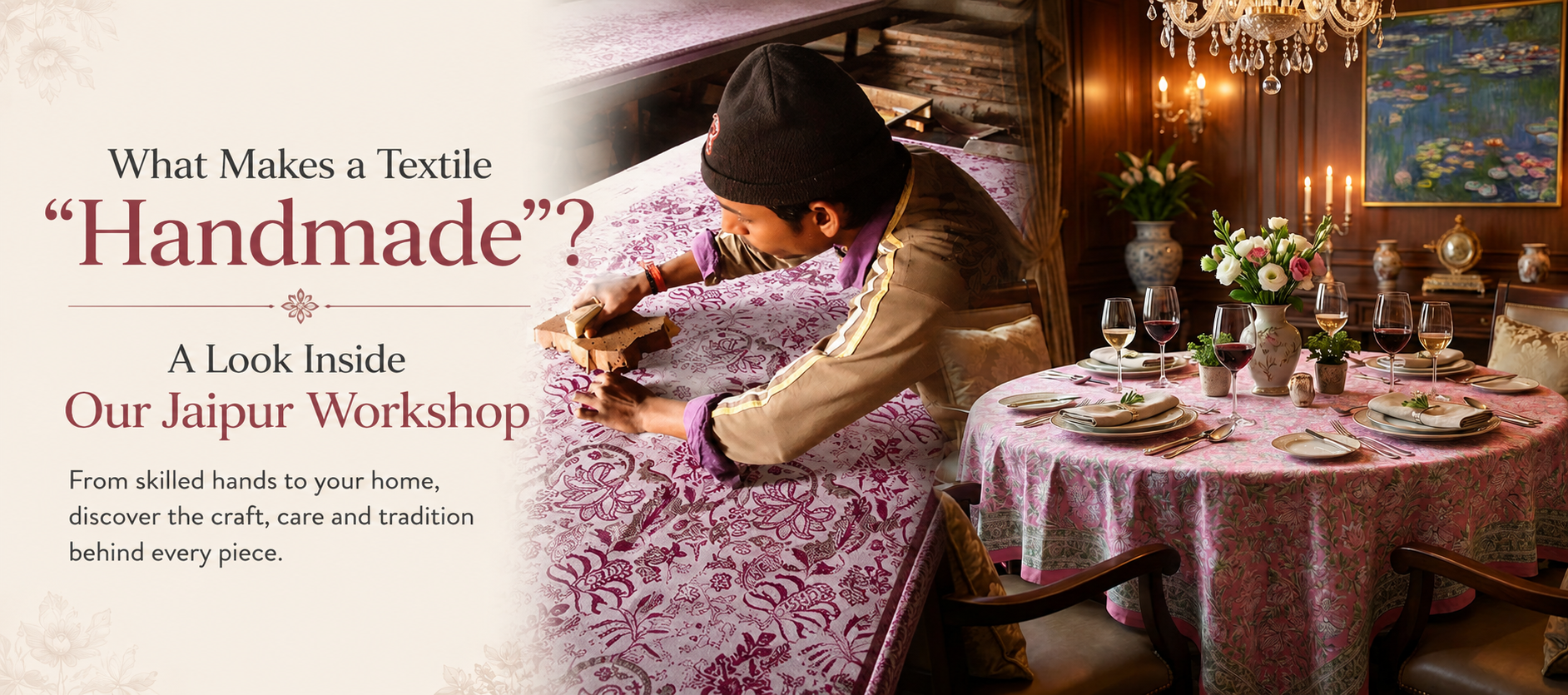
What Makes a Textile "Handmade"? A Look Inside Our Jaipur Workshop
The word "handmade" appears on more product labels than it once did, and not every use of it is accurate. Understanding what makes a fabric handmade means looking past the label and into the actual production process — who touched the cloth, with what tools, and how many separate human stages it passed through before it was finished. Inside a genuine hand block printing workshop in Jaipur, Rajasthan, cloth moves through several distinct manual stages: block carving, dye preparation, hand-stamping, and finishing. None of these are automated. This piece walks through what actually happens at each stage, so a shopper can tell handcrafted textiles apart from machine-printed imitations with more confidence.
A handmade textile is fabric that has been printed, dyed, woven, or stitched primarily by human hands and hand-operated tools rather than by automated machinery. In block printing specifically, this means every pattern is stamped onto the cloth one impression at a time, by a person, using a hand-carved wooden block dipped in dye — repeated hundreds of times across a single length of fabric.
The Real Difference Between Handcrafted and Machine-Printed Fabric
Machine-printed fabric passes through a rotary screen or digital printer at speed, with a single operator overseeing multiple looms or rollers at once. A handcrafted piece, by contrast, is produced one block strike or one stitch at a time by an individual artisan, which is precisely what makes a fabric handmade rather than merely fabric-with-a-pattern. The pace difference is enormous: a rotary printer can finish hundreds of metres in an hour, while a skilled block printer typically completes 8 to 12 metres of fabric in a full working day.
That slower pace shows up in the finished product. Machine printing produces flawless, identical repeats across every metre. Hand block printing produces small, deliberate variations — a slightly shifted motif here, a marginally deeper shade there — because a human hand, not a fixed mechanism, is guiding the process. Buyers who understand this distinction tend to view those variations as a mark of authenticity rather than a flaw.
Inside a Jaipur Block Printing Workshop: The Four-Stage Process
A single block-printed textile passes through four core stages before it ever leaves the workshop floor. Each stage is carried out by a different specialist, and each depends entirely on manual skill rather than mechanical automation.
- Block carving — a master carver etches the design into a seasoned teak or sheesham wood block.
- Dye preparation — natural or pigment dyes are mixed by hand to the correct consistency and colour depth.
- Hand-stamping — the printer presses each carved block onto the stretched fabric, repeating the motif across the full length.
- Washing, drying and finishing — the printed cloth is washed to set the dye, then sun-dried and inspected.
Carving the Wooden Printing Blocks
A single intricate block can take a carver several days to complete, using hand chisels to cut the design in reverse relief. Larger, multi-colour designs require a separate block for each colour layer — some Roopantaran patterns use three or four blocks that must align perfectly on the cloth, a skill passed down through generations of Jaipur's carving families rather than taught in a factory setting.
Mixing and Preparing Natural Dyes
Traditional Rajasthani block printing draws on natural and mineral-based dyes — indigo, madder root, and iron-rust black among them — mixed in small batches by hand to match the exact tone required for that day's run. Because each batch is prepared manually rather than machine-calibrated, no two dye lots are ever perfectly identical, which is part of why handcrafted colour has more depth than a flat, uniform machine print.
Hand-Stamping the Fabric
The printer stretches the cloth across a padded table, dips the carved block into the dye tray, and presses it firmly onto the fabric by hand, striking it once with a mallet to ensure even ink transfer. This is repeated — block, dip, press — thousands of times across a single bolt of cloth, with the printer's eye and hand judging alignment at every step rather than a fixed mechanical guide.
Washing, Drying and Finishing
Once printing is complete, the fabric is washed to remove excess dye and set the colour, then laid out to dry in open air rather than in a heat-set machine chamber. A final hand inspection checks for print clarity and even colour before the piece is approved for stitching or sale.
Five Signs a Fabric Is Genuinely Handmade
A few practical details reveal whether a textile was actually made by hand, even before you read the product description.
- Slight pattern variation — no two repeats sit in exactly the same position, unlike a mechanically fixed print.
- Visible block edges — a faint outline where the wooden block met the cloth, rather than a perfectly bled print.
- Uneven dye penetration — natural dyes sit slightly differently in each fibre, giving colour more depth than a flat machine tone.
- Hand-finished stitching — visible running stitches, as seen in traditional quilted pieces such as indian quilts, where each line is placed individually rather than machine-locked.
- Small batch numbering — genuinely handcrafted ranges are produced in limited runs rather than continuous mass production.
Handcrafted Bedding: What to Look For
Bedding is one of the easiest places to spot the difference between handmade and machine-made textiles, because the printed surface is large and close to the eye. Look at the pattern edges, the drape of the cotton, and the weight of the finished piece.
Block-Printed Bed Coverings
A block print bedspread is stamped entirely by hand, one motif at a time, using the same carved-block process described above. Because no machine is involved, slight variations in pattern placement and colour depth are expected — and are usually the clearest visual proof that the piece is genuinely handcrafted rather than digitally printed to imitate the look.
Quilted Comfort
Quilted styles add an extra hand-worked layer on top of the printing. A queen size quilted bedspread combines block-printed cotton with hand-guided quilting stitches that hold a soft cotton filling in place, giving the fabric texture and light warmth without the weight of a full duvet.
Choosing the Right Fabric Weave for Your Home
Beyond the printing technique, the weave of the cotton itself affects how a handmade textile feels and performs day to day — and this is worth understanding before buying.
Everyday Cotton Weaves
A cotton queen bedspread in a standard weight cotton weave offers breathable, all-season comfort and is easy to maintain with a gentle wash. This makes it a practical everyday choice for UK bedrooms that need bedding suited to a range of temperatures across the year.
Percale and Lightweight Finishes
cotton percale bedding uses a tighter, one-over-one-under weave structure, which gives the fabric a crisp, cool, matte finish. It is a popular choice in British homes for warmer months or for anyone who prefers a smooth, hotel-style hand-feel alongside artisan-printed detail.
Why Handmade Costs More — and Why It Tends to Last Longer
Handcrafted textiles carry a higher price than mass-produced equivalents largely because of labour time, not brand markup. Where a rotary printer might produce several hundred metres of fabric in an hour, a hand block printer completes a fraction of that in a full working day, and every stage from carving to finishing depends on paid, skilled human labour rather than a one-time machine investment.
That labour-intensive process also affects durability. Natural dyes and slow, low-heat finishing tend to be gentler on cotton fibres than high-speed industrial printing, and tightly hand-stitched quilting typically holds up better over repeated washing than glued or heat-bonded alternatives. In practice, well-made handcrafted cotton textiles are often designed to be used for years rather than replaced each season.
Caring for Handmade Cotton Textiles at Home
Handmade cotton pieces are generally low-maintenance, but a few habits help preserve both the print and the fabric. Wash in cold water with a mild detergent to protect natural dye tones, avoid bleach or harsh chemicals that can strip colour, and dry in shade rather than direct sun to prevent fading. Tumble drying on a low setting, or air-drying, also helps preserve stitching on quilted pieces over time.
Frequently Asked Questions
What is the difference between a handmade and a machine-made fabric?
A fabric is handmade when a person, not a machine, performs the core production steps — carving the printing block, mixing the dye, pressing each print by hand, or guiding the stitching. Machine-made fabric is produced by automated rollers or screens at much higher speed, with minimal individual human input per metre.
How can I tell if a bedspread is genuinely hand block printed?
Look closely at the pattern repeat: hand block printing shows small, natural variations in placement and colour depth, along with faint block outlines where the wood met the cloth. A perfectly uniform, flawless repeat across the entire fabric usually indicates machine or digital printing instead.
Are handmade textiles more durable than machine-made ones?
Often, yes. Natural dyes and low-heat, hand-guided finishing tend to be gentler on cotton fibres, and hand-stitched quilting generally withstands repeated washing better than bonded or glued alternatives, so well-made handcrafted pieces are frequently built to last for years of regular use.
Why do handmade textiles cost more than mass-produced ones?
The price reflects labour time rather than markup. A hand block printer typically completes 8 to 12 metres of fabric in a full day, compared with hundreds of metres an hour on a rotary machine, and every stage — carving, dyeing, printing, finishing — is paid, skilled human work rather than a one-off machine cost.
How should I wash and care for handmade cotton bedding?
Wash handmade cotton textiles in cold water with a mild detergent, avoid bleach, and dry in shade rather than direct sunlight to protect natural dye tones. Air-drying or a low tumble-dry setting also helps preserve hand-stitched quilting and printed detail over repeated washes.
In short, handcrafted textiles come down to human hands touching every stage of production — carving, dyeing, printing, and stitching — rather than a machine repeating a fixed pattern at speed. That process is slower and more expensive to produce, but it is also what gives hand block printed cotton its characteristic depth of colour, subtle variation, and durability. Recognising these signs helps a UK shopper choose textiles that are genuinely artisan-made rather than simply styled to look that way.
-
 September 25th, 2026
 -
 September 18th, 2026
 -

The Art of Layering Textiles: How UK Homes Can Mix Quilts & Tablecloths
September 11th, 2026 -

Duvet vs Quilt vs Bedspread: What's the Difference and Which One Do You Need?
September 11th, 2026 -
 August 26th, 2026