
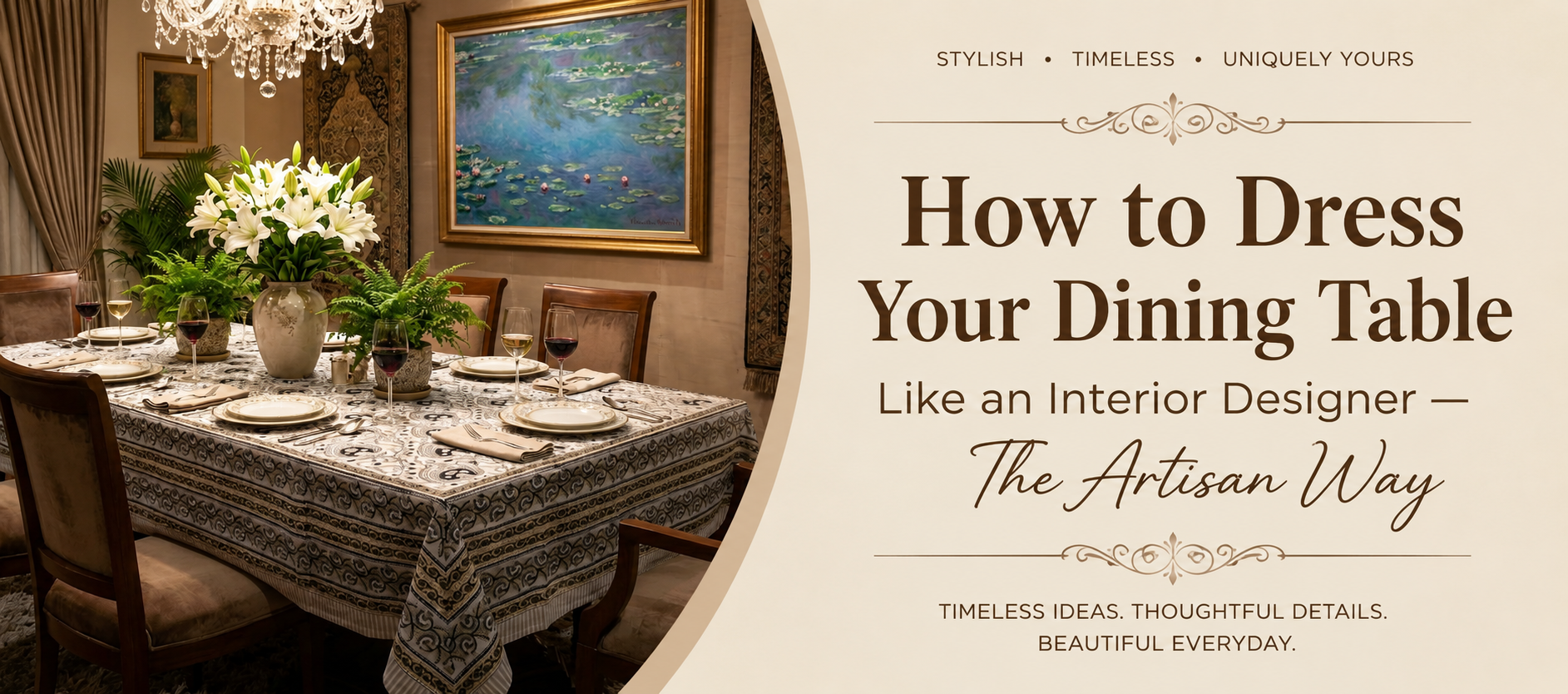
How to Dress Your Dining Table Like an Interior Designer — The Artisan Way
There is something quietly powerful about a beautifully laid dining table. Before a single dish is served, before conversation begins — the table sets a mood. It tells your guests whether they are about to have a hurried weeknight meal or an unhurried, considered experience. In UK homes today, where open-plan living places the dining table at the very centre of the home, the way you dress that table matters more than ever.
Interior designers understand this instinctively. They do not simply throw a cloth down and call it done. They layer textures, balance pattern with plain, and choose pieces that feel collected over time — not purchased all at once from a single shelf. The result always looks effortless, yet it is anything but accidental.
In this guide, we will walk you through exactly how to style a dining table the way a professional would — using thoughtful choices in fabric, form, colour, and layering. And because the finest dining tables deserve the finest linens, we will explore how handcrafted artisan textiles can elevate your table from ordinary to genuinely extraordinary.
“A beautifully dressed table is an act of hospitality before anyone sits down. It says: I made an effort, because you matter.”
Why Your Tablecloth Is the Foundation — Not an Afterthought
Most people think of a tablecloth as purely practical — something to protect the table surface and catch spills. Designers think about it entirely differently. To them, the tablecloth is the single most impactful element in the entire dining room. It sets the colour palette, defines the formality, and introduces the first layer of texture that everything else builds upon.
Choosing the wrong tablecloth can make even the most beautiful crockery look flat. Choosing the right one can make mismatched plates look like a deliberate design decision.
The Designer's Checklist Before Choosing a Tablecloth
- Table shape and size: A tablecloth should always overhang the table edge by at least 20–30 cm on each side. Too short and it looks like a placemat. Too long and it becomes a trip hazard.
- The room's existing palette: Your tablecloth should either anchor the room's existing colours or introduce a single contrasting tone.
- Occasion vs. everyday: The same table can wear a crisp white linen for formal dinners and a warm block-printed cotton for lazy Sunday lunches. Versatility matters.
- Fabric behaviour: Some fabrics hold creases beautifully; others drape with soft fluidity. Neither is wrong — but they create very different moods.
Matching the Tablecloth to Your Table Shape
One of the most practical questions people ask is how to match the shape and size of a tablecloth to their dining table. There is no one-size-fits-all answer, but there are clear principles that make the decision straightforward.
Rectangular and Oval Tables
The most common dining table shape in UK homes, a rectangular table calls for a rectangle tablecloth sized to allow a graceful drop on all four sides. A 4–6 seater table is typically well dressed with a 150 x 220 cm cloth, while an 8–10 seater table benefits from a 180 x 270 cm piece. If your table extends to seat 10–12 guests, a 180 x 340 cm or 200 x 300 cm cloth gives you the full, flowing coverage that makes a long table look truly distinguished.
For oval tables, a rectangular cloth with rounded corner proportions works beautifully — the fabric naturally softens at the ends and creates an elegant gathered effect.
Round and Square Tables
A round table cover cloth should be sized so that it drapes at least 20–30 cm below the table edge on all sides. A 4-seater round table is typically suited to a 150 cm diameter cloth, while a 6-seater round table calls for 180 cm. For larger round tables accommodating 8 or more, a 220–275 cm cloth creates a beautifully full, formal drape.
Square tables follow the same overhang logic as rectangular ones. One styling secret from interior designers: rotate a square cloth 45 degrees on a square table for an immediately more interesting, diamond-shaped presentation.
Styling Tip
For extra warmth and protection of the table surface, lay a thin padding cloth or felt underlay beneath your tablecloth before draping it. This also helps the cloth lie flat and gives the table a more upholstered, luxurious feel.
Table Size / Shape | Recommended Cloth Size | Overhang |
4–6 Seater Rectangle | 150 x 220 cm | ~20–25 cm per side |
8–10 Seater Rectangle | 180 x 270 cm | ~20–30 cm per side |
10–12 Seater Rectangle | 180 x 340 cm / 200 x 300 cm | ~20–30 cm per side |
4 Seater Round | 150 cm diameter | ~25 cm around |
6 Seater Round | 180 cm diameter | ~25–30 cm around |
8–10 Seater Round | 220–275 cm diameter | ~30 cm around |
The Art of Layering — How Designers Build a Table Setting
Understanding how to style a dining table goes beyond simply laying a cloth. The magic of a truly designer-looking table lies in its layers. Think of the table like an outfit — each element adds dimension, and the combination tells a story.
Layer 1: The Tablecloth — Your Foundation
This is your base. Choose a tablecloth in a colour or print that you want to carry through the whole setting. Neutral linen tones work with almost everything; bolder block-print patterns anchor a more maximalist table.
Layer 2: The Table Runner — Direction and Drama
A table runner runs lengthwise across the centre of the table and introduces a contrasting pattern, texture, or colour. Laid on top of a plain cloth, it brings immediate visual interest. Laid on a bare table, it acts as a statement piece in its own right. Interior designers love runners because they are the fastest way to change the entire feel of a table between casual and celebratory settings.
Layer 3: Placemats — Structure and Personalisation
Set a placemat in front of each chair. These define individual place settings and prevent the table from looking like one undifferentiated expanse of fabric. Woven or block-printed placemats in a complementary colour to your tablecloth create cohesion without uniformity.
Layer 4: Napkins — The Finishing Flourish
Cloth napkins are where many people underestimate themselves. A beautifully folded napkin placed to the left of the plate, or tucked inside a wine glass, immediately elevates the setting from functional to formal. For a relaxed everyday table, fold your napkin simply in thirds and lay it beneath the fork. For dinner parties, try the bishop's hat fold or a simple envelope fold for a sharp, deliberate look.
Layer 5: Centrepiece — Height and Life
The centrepiece should draw the eye upward, adding dimension to the otherwise flat table. Candles in varying heights, a low bowl of seasonal fruit, a single vase of wildflowers, or an artisan ceramic bowl all work beautifully. Keep centrepieces low enough that guests can see each other across the table — nothing disrupts a dinner party like a conversation broken by a flower arrangement.
Choosing Patterns and Colours the Designer Way
Colour is where many people hesitate, and pattern is where many more pull back entirely. Designers take a different approach: they choose one dominant pattern and build everything else around it as a supporting act.
The 60-30-10 Rule for Table Styling
Interior designers use a simple ratio: 60% of the table should be one dominant colour or neutral, 30% should be a secondary complementary tone, and 10% should be an accent — a pop of something unexpected. Applied to a dining table, this might mean a warm cream tablecloth (60%), terracotta-printed napkins and a matching runner (30%), and a small centrepiece with cobalt blue ceramics (10%).
Pattern Mixing Without Chaos
The key to mixing patterns confidently is scale. Pair a large-scale block print with a small geometric motif, and they will complement rather than compete. Avoid placing two patterns of the same visual weight together — they will fight for dominance and the table will feel busy rather than curated.
Traditional Indian block-printing techniques produce patterns with enormous variety — from fine florals to bold paisleys to geometric medallions — making them especially versatile for mixing and matching within a single table setting.
Why Artisan Textiles Transform a Dining Table
There is a meaningful difference between a mass-produced tablecloth and a handcrafted one. It is not merely aesthetic — it is sensory. An artisan-made textile has a quality of surface and substance that machine-made fabrics rarely achieve. The slight irregularity of a hand-stamped block print, the warm texture of cotton that has been handled by skilled hands at every stage of production — these qualities are immediately perceptible when you touch and use the piece.
In the UK, there is a growing movement of home decorators who are moving away from fast interiors and toward considered, lasting pieces. Handcrafted dining linens fit perfectly into this ethos. They are practical — machine washable, hard-wearing, and made to last — while also being genuinely beautiful in the way that only something made by hand can be.
The Case for Indian Block-Print Cotton
Indian block-print textiles have been celebrated globally for centuries, and their enduring appeal is easy to understand. Created by hand-stamping wooden blocks dipped in natural dyes onto cloth, each print is unique. No two tablecloths are identical — small variations in pressure, alignment, and colour saturation give every piece its own character.
For UK homes in particular, a block print cotton tablecloth brings a warmth and visual richness that works beautifully with both period properties and contemporary interiors. A Victorian terrace kitchen, a converted barn, a modern London flat — block-print textiles have a chameleon quality that allows them to read as heritage or contemporary depending on what surrounds them.
“A hand-block printed tablecloth is not just a piece of fabric — it is a record of a craftsperson's skill, carried forward from centuries of tradition into your home.”
Sourcing Thoughtfully: Why Origin Matters
When choosing dining linens, origin matters. Brands like Roopantaran, rooted in Jaipur, Rajasthan — India's heartland of block-print textile production — work directly with skilled artisans whose families have practised these crafts across generations. Choosing such pieces is a form of conscious consumption: you are investing in a tradition, not just a product.
For UK shoppers who value sustainability and ethical production, purchasing Indian tablecloths online from artisan-led brands offers both quality assurance and the knowledge that the purchase supports genuine craft communities.
Styling for Every Occasion — From Weeknight to Wedding Breakfast
The Everyday Table
For daily family meals, the goal is comfort and easy maintenance. A block-print cotton tablecloth in a warm neutral — sand, terracotta, or sage — is forgiving of everyday life while still looking considered. Pair it with simple cotton napkins and a small vase of whatever is in season. Avoid fussy details that will feel like too much effort to reset each morning.
The Dinner Party Table
Entertaining calls for a more layered approach. Use your most beautiful tablecloth as the base, add a complementary runner, and invest time in the napkin presentation. Introduce candles in varying heights for warmth and intimacy. The secret is to keep the centrepiece arrangement low and the individual place settings generous in space — nothing says "considered host" like a table that does not feel cramped.
The Festive Table
Seasonal celebrations — Christmas, Easter, Diwali, Eid, a birthday supper — call for a table that feels genuinely festive without resorting to disposable paper decorations. A long tablecloth in a deep jewel tone — saffron, peacock blue, deep berry — instantly creates occasion. Layer with gold-toned accents, seasonal foliage, and your best crockery for a table that will be remembered.
The Outdoor and Garden Table
Summer dining in the UK garden is a very particular pleasure. For outdoor tables, choose 100% cotton tablecloths that can handle a breeze without flying off — slightly heavier weaves perform better outdoors. A block-print pattern in botanical or geometric motifs works beautifully against the natural backdrop of a garden setting. For round garden tables, a round table cover in a cheerful print sets the mood the moment guests step outside.
Common Dining Table Styling Mistakes — and How to Avoid Them
- Choosing the wrong size tablecloth: Always measure your table before buying. A cloth that finishes level with the table edge looks like it shrank in the wash. Allow a minimum 20 cm drop on each side.
- Matching everything too precisely: A table where every element is matchy-matchy looks like a hotel package, not a home. Introduce intentional variations in colour or print to give the table life.
- Ignoring texture: Even within a single-colour palette, a table with multiple textures — woven cotton, smooth ceramic, rough rattan, hammered metal — has far more visual interest than one that is textually flat.
- Overcrowding the centrepiece: A centrepiece is an accent, not a statement. If your guests cannot see the person across from them, the centrepiece has defeated its own purpose.
- Neglecting napkins: Paper napkins at a dinner party communicate effort only on the practical level. Cloth napkins, even casually folded, communicate thought and hospitality.
Care and Longevity — Making Your Table Linens Last
Good-quality dining linens are an investment, and with the right care they last for years — often improving with age, as cotton softens and prints develop a gentle, worn-in character.
Washing Block-Print Cotton Linens
Machine wash at 30°C or below on a gentle cycle. Avoid harsh detergents or bleach, which will strip natural dyes. Washing separately in the first few washes prevents dye transfer to other fabrics. Tumble dry on low or, better still, air dry — natural fibres breathe and shape best when dried flat or on a washing line.
Ironing and Storage
Iron tablecloths while slightly damp for the best results. For block-printed cloths, iron on the reverse side to protect the surface of the print. Fold and store in a cool, dry place away from direct sunlight, which can fade natural dye colours over time. If possible, store with a fold along the length of the runner or cloth rather than at the midpoint — this minimises visible crease lines on the table.
A Final Word: The Table as a Place of Connection
The dining table is one of the few spaces in our lives that is genuinely communal. It is where families negotiate the day, where friendships deepen over a long meal, where celebrations are marked. When you take the time to dress it beautifully, you are not decorating furniture — you are setting the stage for something human.
Artisan textiles understand this intuitively. A handcrafted tablecloth carries within it the hours of someone else's skilled labour, the tradition of a craft refined over generations, and the warmth of a material made by hand from natural fibres. Placed on your table, it becomes part of the story of your home.
The next time you think about how to style a dining table, start not with the crockery or the flowers but with the cloth beneath them. Choose something made with intention, and everything that follows will feel better for it.
Frequently Asked Questions
What is the best tablecloth material for everyday dining use?
100% cotton is widely regarded as the best choice for everyday dining. It is breathable, easy to launder, durable, and comfortable to the touch. Block-print cotton tablecloths are especially popular in the UK for combining practicality with genuine artisan character — the kind of surface quality that mass-produced alternatives cannot replicate.
How do I choose the right tablecloth size for my dining table?
The standard guideline is to allow a drop of 20–30 cm on each side of the table. For a 4–6 seater rectangular table, a 150 x 220 cm tablecloth is ideal. For larger tables seating 8–10, go for 180 x 270 cm. For round tables, measure the table's diameter and add at least 40–60 cm total to achieve a proper, graceful overhang on all sides.
Can I use a round tablecloth on a square or rectangular table?
Yes — using a round cloth on a square or rectangular table creates a relaxed, eclectic aesthetic that works well in informal or bohemian interior settings. The fabric pools gently at the corners, creating a soft, gathered effect. It is a technique often used by designers to introduce deliberate nonchalance into a table setting.
How do I layer a dining table with runners and placemats?
Start with a tablecloth as your base layer. Lay a table runner across the centre of the table lengthwise for a formal look, or diagonally for a relaxed feel. Place individual table mats in front of each seat. Finish with folded cloth napkins placed to the left of each setting. This layering technique adds depth, texture, and the kind of considered character that makes a table look genuinely designed rather than simply dressed.
Are Indian block-print tablecloths suitable for UK homes?
Absolutely. Indian block-print tablecloths are remarkably versatile and suit UK homes beautifully — whether in a modern city flat, a period farmhouse, or a Scandi-influenced kitchen. Their handcrafted patterns bring warmth and authenticity to neutral interiors, and their 100% cotton construction makes them eminently practical for day-to-day use. They are available in both quiet neutral palettes and rich jewel tones, making it easy to find a piece that complements your existing décor.
-
 September 18th, 2026
 -
The Art of Layering Textiles: How UK Homes Can Mix Quilts & Tablecloths
September 11th, 2026 -
Duvet vs Quilt vs Bedspread: What's the Difference and Which One Do You Need?
September 11th, 2026 -
 August 26th, 2026