
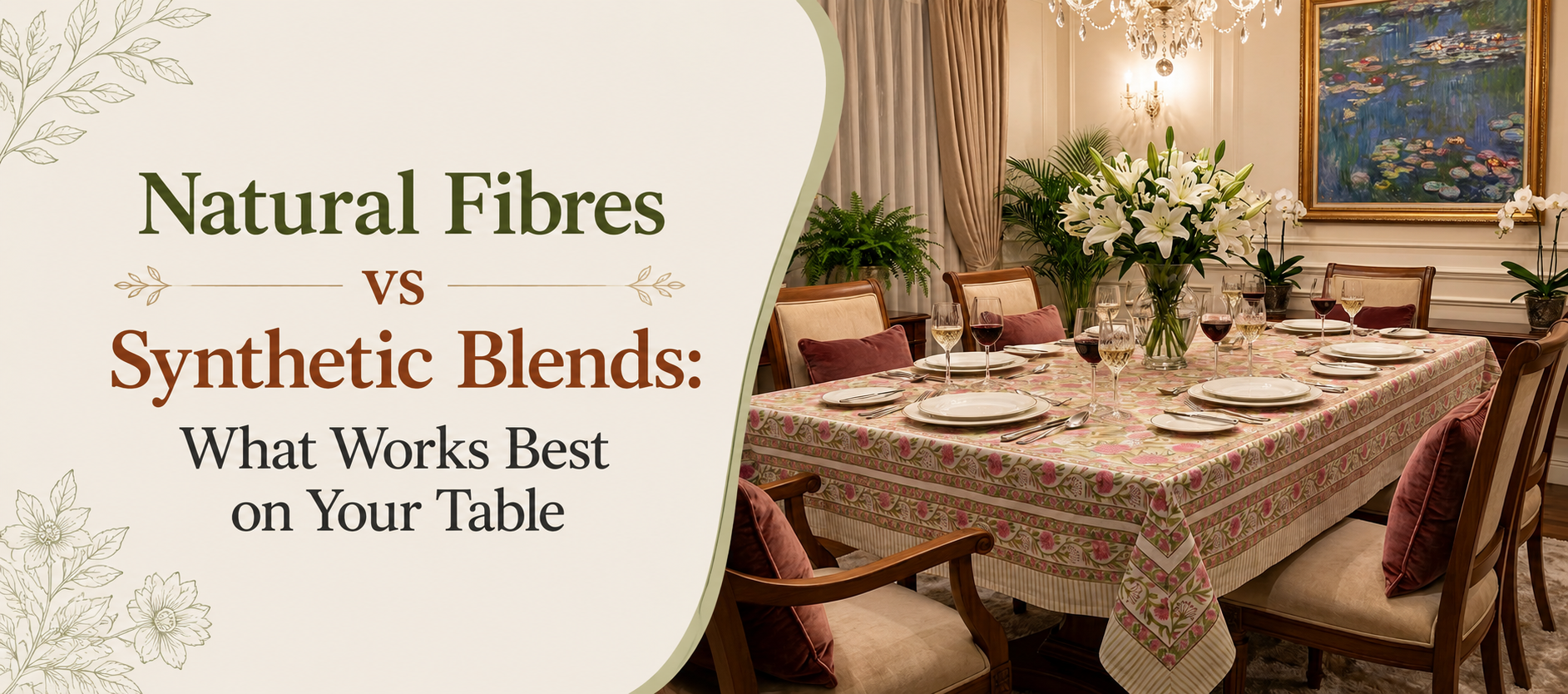
Natural Fibres vs Synthetic Blends: What Works Best on Your Table
When you smooth a cloth over the dining table before guests arrive, you're making a decision that goes well beyond colour and pattern. The fabric itself determines how your table feels, how it ages, and how it sits within a home that increasingly values where things come from. For UK households weighing up natural fabric vs synthetic fabric for everyday dining and special occasions alike, the answer has as much to do with heritage and hand craftsmanship as it does with thread count or care labels.
What Your Tablecloth Is Really Made Of — And Why It Matters
Why Table Fabric Choice Matters More Than It Seems
A tablecloth is one of the few textiles in a home that touches almost every meal, every gathering, and every quiet weekday breakfast. Unlike a cushion cover or a throw, it is laundered often, exposed to spills, heat, and sunlight, and handled directly by everyone at the table. That frequency of use means the fibre composition matters enormously — far more than most shoppers realise when they're simply browsing for a pattern they like.
Fabric choice also speaks to a household's wider values. A growing number of UK shoppers are rethinking what fills their homes, moving away from disposable, mass-produced items and toward pieces with a story, a provenance, and a longer working life. Dining linens sit right at the centre of that shift, because they're visible, tactile, and used daily rather than tucked away.
What "Natural" Actually Means in Textile Terms
Natural fabrics are woven from fibres that occur in nature and are processed with minimal chemical intervention — cotton from the cotton plant, linen from flax, wool from sheep, silk from silkworm cocoons. These fibres are biodegradable, breathable, and have been used in textile-making for thousands of years, refined through generations of weaving and dyeing knowledge long before industrial manufacturing existed.
Cotton, in particular, has earned its place as the most widely used natural fibre for home textiles. It absorbs moisture readily, softens with every wash rather than degrading, and takes dye beautifully — which is precisely why it has remained the fabric of choice for hand-printed textiles across Rajasthan for centuries. Its breathability also makes it forgiving in a way synthetic fabrics simply aren't; a cotton cloth left over a table on a warm afternoon won't trap heat or feel clammy to the touch.
What "Synthetic" Means and Where It Comes From
Synthetic fabrics, by contrast, are manufactured from petroleum-derived polymers. Polyester, nylon, and various poly-cotton blends fall into this category. They're engineered in a lab rather than grown in a field, which gives manufacturers precise control over consistency, but at a cost: synthetic fibres don't biodegrade, and producing them relies on fossil-fuel-based chemical processes from start to finish.
This isn't to say synthetic fabric has no merit. It resists creasing, dries quickly, and is often cheaper to produce at scale, which is why it dominates budget homeware ranges and outdoor or event-hire tablecloths where durability against the elements matters more than tactile quality. But those practical advantages come with trade-offs that become more apparent the longer a piece is used.
Comfort and Feel: The Everyday Difference
Run a hand across a natural cotton cloth and a polyester one side by side, and the difference is immediate. Cotton has a soft, slightly textured hand-feel that improves with washing, while synthetic fabric tends to feel uniform, slightly stiff, and can develop a faint sheen that reads as artificial under indoor lighting. For a dining table — somewhere food is shared and hands rest for long stretches — that tactile quality genuinely affects the experience of a meal.
Breathability plays a role here too. Cotton allows air to pass through the weave, which means a cloth doesn't trap condensation from warm dishes or cause that slightly damp feeling synthetic fabrics are prone to in humid conditions — something especially relevant in a British climate where indoor heating and changeable weather both come into play across the year.
Durability and Longevity Over Time
It's a common assumption that synthetic fabric automatically outlasts natural fibre, but the reality is more nuanced. Cheaply made polyester blends can pill, fade under direct sunlight, and develop a worn, slightly plasticky texture within a couple of years of regular use. Well-made natural cotton, particularly cotton woven and finished using traditional methods, tends to soften and mellow rather than degrade — many heirloom textiles from Rajasthan are still in daily use decades after they were made.
The deciding factor isn't really fibre type in isolation; it's the quality of the weave and the finishing process behind it. A densely woven, well-finished cotton cloth will consistently outperform a thin, low-grade synthetic one, even though synthetic fabric has a reputation for resilience. Provenance and craftsmanship often matter more than the raw material category alone.
Caring for Hand Block Printed Dining Linens
Hand-finished cotton does ask for a little more attention than a wipe-clean synthetic sheet, but the routine is simple once established. block print tablecloths should be washed in cool or lukewarm water, ideally by hand or on a gentle machine cycle, to protect both the natural dye and the integrity of the hand-printed pattern. Avoid harsh bleach or high-heat tumble drying, as both can dull the colour saturation that comes from traditional block printing methods.
Ironing on a moderate heat while the cloth is still slightly damp helps the cotton sit smoothly without flattening the subtle texture that comes from hand printing. This small extra care is part of what makes the fabric feel genuinely considered rather than disposable — a quality that's increasingly hard to find in synthetic alternatives designed for convenience above all else.
The Environmental Cost of Synthetic Fabric
Synthetic textiles carry an environmental footprint that's easy to overlook at the point of purchase. Polyester and similar fibres shed microplastics with every wash, releasing particles that make their way into waterways and, eventually, the ocean. Because these fibres don't biodegrade, a synthetic tablecloth that's discarded after a few years of use will persist in landfill for centuries.
Natural cotton, particularly when grown and processed without intensive chemical treatment, breaks down naturally at the end of its working life and avoids contributing to the microplastic pollution synthetic fibres are now widely recognised for. For UK shoppers who already think carefully about food waste or single-use plastic in the kitchen, the same scrutiny is increasingly being applied to the textiles that surround that kitchen table.
Sourcing Hand-Printed Cotton Designs Responsibly
Provenance has become a meaningful filter for considered homeware purchases, and dining linens are no exception. A block print cotton tablecloth made in Jaipur and Sanganer — two of Rajasthan's most established centres for hand-block printing — carries a level of craftsmanship that simply cannot be replicated by machine. Artisans use hand-carved wooden blocks dipped in natural or low-impact dyes, pressing each repeat by hand across the length of the fabric.
That process means no two cloths are entirely identical, and small irregularities in the pattern are a mark of genuine handwork rather than a flaw. Choosing a responsibly sourced, artisan-made cotton cloth also supports the livelihoods of skilled textile communities whose craft has been passed down through generations — a very different proposition to a synthetic cloth manufactured anonymously on an industrial line.
Choosing the Right Shape for Rectangular Tables
Fabric quality matters, but fit matters just as much for a tablecloth to look intentional rather than simply draped on. rectangle tablecloths remain the most common shape for British dining tables, suiting everything from a compact four-seater in a kitchen diner to a ten-seater laid out for a family gathering. Measuring table length and width before buying, then adding 20–30cm of overhang on each side, is the simplest way to get proportions right.
Natural cotton holds its drape particularly well on rectangular tables, falling in soft, even folds rather than the stiffer hang typical of synthetic fabric. That drape quality is subtle, but it's exactly the kind of detail that separates a table that looks styled from one that simply has a cloth thrown over it.
Getting the Proportions Right for Circular Tables
Circular dining tables call for their own sizing logic. A round table cover cloth should be measured against the table's diameter, with an additional 30–45cm added to achieve an elegant overhang that doesn't pool on the floor or fall short and look undersized. Round tables tend to suit smaller dining spaces or more intimate gatherings, and the right cloth proportion makes a noticeable difference to how finished the setting feels.
Natural cotton again proves its worth here: the fabric's give and softness allow it to settle naturally around curved table edges, whereas stiffer synthetic fabric can sit awkwardly or pucker at the corners of a rounded drop.
Dressing Extended Tables for Bigger Gatherings
For banquet-style dining, extended family tables, or event hosting, long tablecloths need to hold their shape and colour across a much larger surface area without becoming difficult to manage during laundering. Densely woven natural cotton handles this well, resisting sagging in the centre and maintaining even colour distribution from one end of the table to the other, even after repeated washing.
This is one area where the quality of the weave genuinely outweighs fibre type alone — a well-constructed cotton cloth in a long format will outperform a thinner synthetic equivalent of the same length, particularly when it comes to retaining its shape over a full evening of use.
Suiting Everyday and Special Occasion Round Tables
Beyond formal dining, round table covers are equally suited to everyday breakfast tables, garden bistro sets, or smaller occasional tables that see regular use throughout the week. A natural cotton cover in this context offers the practical benefit of being machine washable and quick to refresh, while still bringing genuine texture and warmth to a space that a synthetic equivalent tends to flatten visually.
Because these smaller round formats are handled and laundered more frequently than larger banquet cloths, the longevity advantage of natural cotton becomes even more apparent over a year of regular use.
Making the Decision for Your Own Table
There's no single universally correct answer in the natural fabric vs synthetic fabric question — context matters. A synthetic cloth might genuinely suit an outdoor catering setup exposed to rain and heavy turnover, where wipe-clean convenience outweighs tactile quality. But for a home dining table, used daily and central to family life, natural cotton consistently offers better breathability, a softer hand-feel, a lower environmental footprint, and — when hand-block printed — a connection to genuine artisan craft that no synthetic alternative can replicate.
For UK households building a home around considered, long-lasting pieces rather than disposable ones, that combination of comfort, sustainability, and authentic provenance tends to make the decision a straightforward one.
FAQs
Is cotton better than polyester for tablecloths?
For everyday home dining, yes — cotton is more breathable, softer against the skin, and biodegradable. Polyester resists creasing and is cheaper, but tends to feel stiffer and doesn't age as gracefully as well-made natural cotton.
Do natural fabric tablecloths shrink in the wash?
Good-quality cotton is typically pre-shrunk during finishing, so shrinkage with cool or lukewarm washing is minimal. Always check the specific care label, as treatment can vary between weaves and finishes.
Are synthetic tablecloths bad for the environment?
Synthetic fabrics are petroleum-based, don't biodegrade, and shed microplastics during washing. Natural cotton breaks down naturally at the end of its life, making it the more sustainable choice for environmentally conscious households.
How do I know if a tablecloth is genuinely hand block printed?
Genuine hand-block printed cloth shows slight irregularities in pattern repeats — a mark of human craftsmanship rather than machine precision. Uniform, perfectly aligned prints usually indicate digital or screen printing instead.
What size tablecloth do I need for my table?
Measure your table's length and width (or diameter for round tables), then add 20–30cm overhang per side for rectangular tables or 30–45cm for round tables, depending on how much drop you prefer.
-
 September 18th, 2026
 -
The Art of Layering Textiles: How UK Homes Can Mix Quilts & Tablecloths
September 11th, 2026 -
Duvet vs Quilt vs Bedspread: What's the Difference and Which One Do You Need?
September 11th, 2026 -
 August 26th, 2026