
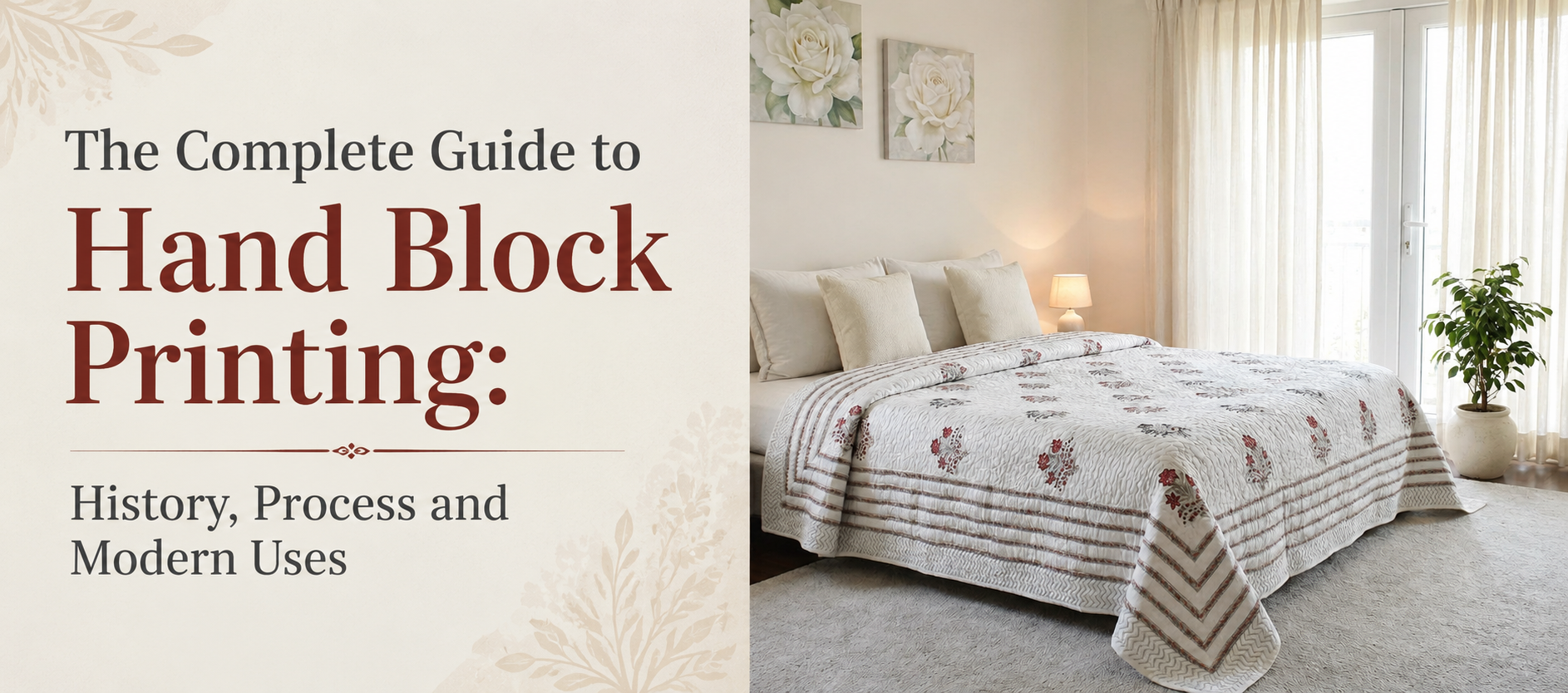
The Complete Guide to Hand Block Printing: History, Process and Modern Uses
How Hand Block Printing Evolved Through the Centuries
Some crafts survive for centuries not because they have been preserved behind glass, but because they remain genuinely useful, deeply beautiful, and impossible to replicate by machine. Hand block printing is one of those crafts. Practised for well over a thousand years across the Indian subcontinent, it continues to dress dinner tables, bedrooms, and wardrobes in homes across the UK today — not as a novelty, but as a considered alternative to the mass-produced norm. This guide covers the full story: where the tradition came from, how it is done, why the results look the way they do, and the many ways it appears in contemporary homes and wardrobes.
Defining the Craft: Technique, Tools and Tradition
At its simplest, what is hand block printing can be answered in one sentence: it is a method of applying pattern to fabric using hand-carved wooden blocks dipped in dye or pigment and pressed, repeat by repeat, across the cloth's surface. But that single sentence barely touches what the process involves in practice.
The wooden blocks themselves — known in Rajasthan as bunta — are typically carved from teak or sheesham (Indian rosewood), chosen for their density and ability to hold fine detail. A skilled carver may spend several days producing a single block, cutting the negative space away to leave a raised motif of extraordinary precision: a five-petalled flower, a geometric lattice, a curling vine or a dense paisley. More complex patterns require multiple blocks, each carrying a different element of the design, applied in sequence over the same cloth with careful alignment.
Once the blocks are ready, the fabric — almost always natural cotton, prized for its absorbency — is stretched across a padded printing table. The block is pressed into a pigment tray, then stamped firmly and evenly onto the cloth. The artisan lifts and repositions to the next repeat, working along the fabric with a rhythmic precision that comes only from years of practice. A single tablecloth might require hundreds of individual impressions.
A Thousand Years of Indian Printing History
The origins of block printing in India can be traced to at least the 12th century, with some scholars placing its roots considerably earlier. The regions of Rajasthan — particularly Jaipur, Sanganer and Bagru — became the most celebrated centres for the craft, developing distinctive regional styles that are immediately recognisable today.
Sanganer printing is characterised by fine, delicate floral and geometric motifs applied to white or off-white backgrounds, traditionally using mineral and vegetable-based dyes. Bagru printing, by contrast, favours earthy tones — ochres, indigos, rust reds and deep greens — achieved through a mud-resist process that predates synthetic colour by centuries. Both traditions were refined through royal patronage: the Maharajas of Jaipur actively supported local artisan communities, and the city's textile production became famous across trade routes that reached Europe, Persia and beyond.
The British East India Company's trade with Mughal India brought block-printed cottons — called chintzes — to European homes in the 17th and 18th centuries, where they caused something approaching a cultural sensation. The patterns were unlike anything European looms could produce, and demand became so intense that several European governments briefly imposed import bans to protect their own weaving industries. The craft's influence on European textile design — from Victorian chintz to mid-century botanical prints — runs deeper than most people realise.
How a Block Printed Fabric Is Made: Stage by Stage
Understanding the full production sequence helps explain both the value of hand-block printed textiles and their characteristic appearance.
Fabric preparation: Raw cotton is washed repeatedly to remove sizing and natural oils, then treated with a mordant — typically alum or tannin — that helps the dye bond permanently to the fibre. This stage determines whether colour will remain vivid after repeated washing.
Block carving: The design is transferred to the block surface and carved by hand. Relief carving leaves the pattern raised; the background is cut away. Fine detail work — veins in a leaf, the dots of a lattice — requires specialist carvers who have practised for years.
Colour mixing: Pigments are prepared on a flat printing pad. Natural dyes — indigo, pomegranate, madder root, turmeric — require more complex preparation than synthetic alternatives, but produce tones with a depth and subtlety that resists exact digital imitation.
Printing: The artisan works methodically across the stretched fabric, stamping each repeat by eye and feel. Registration guides — small pins on the block's edge — help maintain alignment, but the subtle imprecisions that occur are intrinsic to hand printing: they confirm human authorship.
Washing and finishing: Once printed, the fabric is washed to remove excess pigment and fix colour, then dried in open air. Sun-drying is preferred; it brightens certain natural dyes rather than dulling them.
From the Workshop to the Dining Table
The dining table is one of the most natural settings for hand-block printed textiles. A block print cotton tablecloth brings pattern and provenance to everyday meals without the stiffness of formal linen or the disposability of printed polyester. Because cotton is naturally absorbent and machine washable, it handles the realities of family dining well — and because each cloth is individually printed, no two are identical even within the same colourway.
The motifs most commonly used for dining linens — floral repeats, trellis patterns, geometric border designs — are among the oldest in the Rajasthani repertoire. Seeing them on a laid table connects the domestic space to a craft tradition that long predates printed homeware as a commercial category.
The Art of the Printed Quilt
Block printing and quilting have coexisted in Indian textile practice for centuries. The combination of printed cotton with hand-stitched layering produces objects that function simultaneously as bedding and as crafted artefacts. For UK homes where natural materials and considered aesthetics are valued, the appeal is easy to understand. When you browse cotton quilts online, the patterns you see are the direct descendants of motifs carved in wood across Rajasthan's print workshops.
A block-printed quilt carries something a digitally printed alternative cannot: evidence of the hand. The slight variation in ink saturation from one stamp to the next, the way a motif sits at a fractional angle — these are not flaws. They are signatures.
Bedrooms and the Heritage Aesthetic
Beyond quilts, hand block printing translates beautifully to bedspreads — lighter than quilts and ideally suited to the variable temperatures of a British bedroom through spring and autumn. A cotton queen bedspread printed by hand brings a layer of visual richness to a bedroom that is very difficult to achieve with machine-printed alternatives at the same price point. The coverage is generous, the cotton breathes, and the pattern — whether floral, geometric or botanical — carries the kind of depth only a carved wooden block can deliver.
Why Natural Cotton Makes All the Difference
To fully appreciate what is hand block printing in practice, it helps to understand why the fabric choice matters so much. The process depends on natural fibres — cotton, linen, silk — because they absorb dye at a molecular level in a way synthetic materials cannot. Polyester simply does not take natural pigments the same way; the colour sits on the surface rather than bonding to the fibre, and the hand of the printed result is quite different.
Natural cotton also ages differently from synthetic alternatives. Washed repeatedly over time, it develops a softness and a slight patina that enhances rather than diminishes its character. A block-printed cotton textile that has been well cared for tends to look better after ten washes than it did on day one.
Carrying the Craft: Bags and Everyday Accessories
Hand block printing is not confined to the home. The same technique that produces fine bedding and dining linens is equally at home on accessories designed for daily life. Block printed tote bags represent one of the most practical expressions of the craft: durable, washable, and carrying a pattern that will outlast any fast-fashion alternative. Because each bag is individually printed rather than mass-produced, it functions as a small piece of wearable heritage — appropriate to the slow-fashion values that motivate a growing number of UK consumers.
Scaling Up: Large-Format Printed Bedding
One of the most impressive demonstrations of an artisan's skill is watching a large-format piece take shape — a cloth printed repeat by repeat until the full surface is covered in precisely aligned pattern. A king size quilted bedspread requires the artisan to maintain consistent pressure, alignment and ink saturation across a very large surface area. The result, when done well, looks almost impossibly regular for something produced entirely by hand — which is precisely why it rewards close inspection.
Proportion, Pattern and the Double Bed
For the double bed — the most common sleeping configuration in UK homes — a well-proportioned block-printed quilt transforms the bedroom completely. Queen size quilts printed by hand offer the advantage of all-over pattern coverage at exactly the right scale: large enough to drape over the bed properly, and patterned with motifs that have been refined over generations to read well at sleeping distance. The heritage design vocabulary of Jaipur's print tradition — floral medallions, flowing vines, fine geometric borders — translates with particular elegance to the double-bed format.
Contemporary Relevance: Slow Fashion and Conscious Buying
Hand block printing sits at an interesting intersection in contemporary consumer culture. On one side, the global fast-fashion and fast-home markets continue to produce printed textiles at unprecedented volumes and minimal cost. On the other, a growing number of UK buyers are actively seeking out alternatives: products with traceable provenance, genuine craft content, and the kind of longevity that makes the purchase feel responsible rather than impulsive.
Hand block printing answers all of those criteria. It supports skilled artisan communities whose livelihoods depend on the continuation of the craft. It uses natural materials and predominantly low-impact dyes. It produces textiles that do not become obsolete when trends change, because the patterns are rooted in a design heritage that long pre-dates seasonal fashion cycles.
This is why hand-block printed textiles — bedspreads, tablecloths, garments, tote bags — appear increasingly in the conversations around ethical consumption and thoughtful home styling. They are not heritage objects preserved in aspic; they are genuinely functional, washable, everyday things that happen to have been made the right way.
How to Look After Block-Printed Cotton at Home
Block-printed cotton requires no more care than other quality cotton textiles, but a few habits help maintain the depth of colour over time. Washing at 30°C or 40°C on a gentle cycle preserves pigment better than hot washing. Turning the fabric inside out before placing it in the machine protects the printed surface from abrasion. Line drying is preferable to tumble drying — air and natural light treat printed cotton far more kindly than heat.
Avoid bleach-based detergents, which will strip natural dyes. A mild, colour-safe liquid detergent is sufficient for everyday washing. If the textile develops slight creasing from storage or washing, a warm iron on the reverse side restores the fabric quickly without risking the printed surface.
With reasonable care, a well-made block-printed cotton piece will remain in use for years. That lifespan — and the story it continues to carry — is exactly what distinguishes it from printed alternatives produced at a fraction of the cost and with a fraction of the intention.
Frequently Asked Questions
How long does a wooden block last in hand block printing?
A well-maintained teak or sheesham block can last for decades of regular use. Artisans clean blocks after each print session and store them carefully to prevent warping. Over time, very fine carved details may soften slightly with use, but this gradual quality is often considered part of the printed textile's character.
Will the colour in a block-printed cotton textile fade after washing?
Some initial colour release is normal in the first wash, particularly with natural-dye pieces. After that, colour stability is very good with cool machine washes and colour-safe detergents. Avoid bleach-based products and tumble drying on high heat, both of which accelerate fading in any dyed textile regardless of production method.
What is the difference between hand block printing and screen printing?
Screen printing uses a mesh stencil through which dye or pigment is pushed by a squeegee, typically producing very crisp, even coverage. Hand block printing uses a carved wooden block pressed by hand, which results in slight variations in ink saturation and alignment across the repeat — the hallmark of genuine artisan work. Both are manual processes, but block printing requires no photographic or screen-making equipment.
Can hand block-printed textiles be used outdoors?
Block-printed cotton is not UV-stabilised for prolonged outdoor exposure, so it is best used indoors or in sheltered outdoor settings for temporary occasions such as garden dining. Tablecloths and napkins used outdoors occasionally should be washed and dried promptly to prevent colour transfer from damp conditions.
How can I tell if a block-printed textile is genuinely handmade?
Authentic hand block printing shows subtle repeat variations — slight shifts in alignment, minor differences in ink saturation from one impression to the next, and occasional small gaps at pattern joins. These are not defects but evidence of human production. Machine-printed or screen-printed imitations tend to be perfectly regular across the full length of the cloth, which is actually a useful diagnostic indicator.
-

Why Hand Block Printed Home Furnishings Are Getting Popular in the UK
October 16th, 2026 -
 October 2nd, 2026
 -
 September 25th, 2026

