
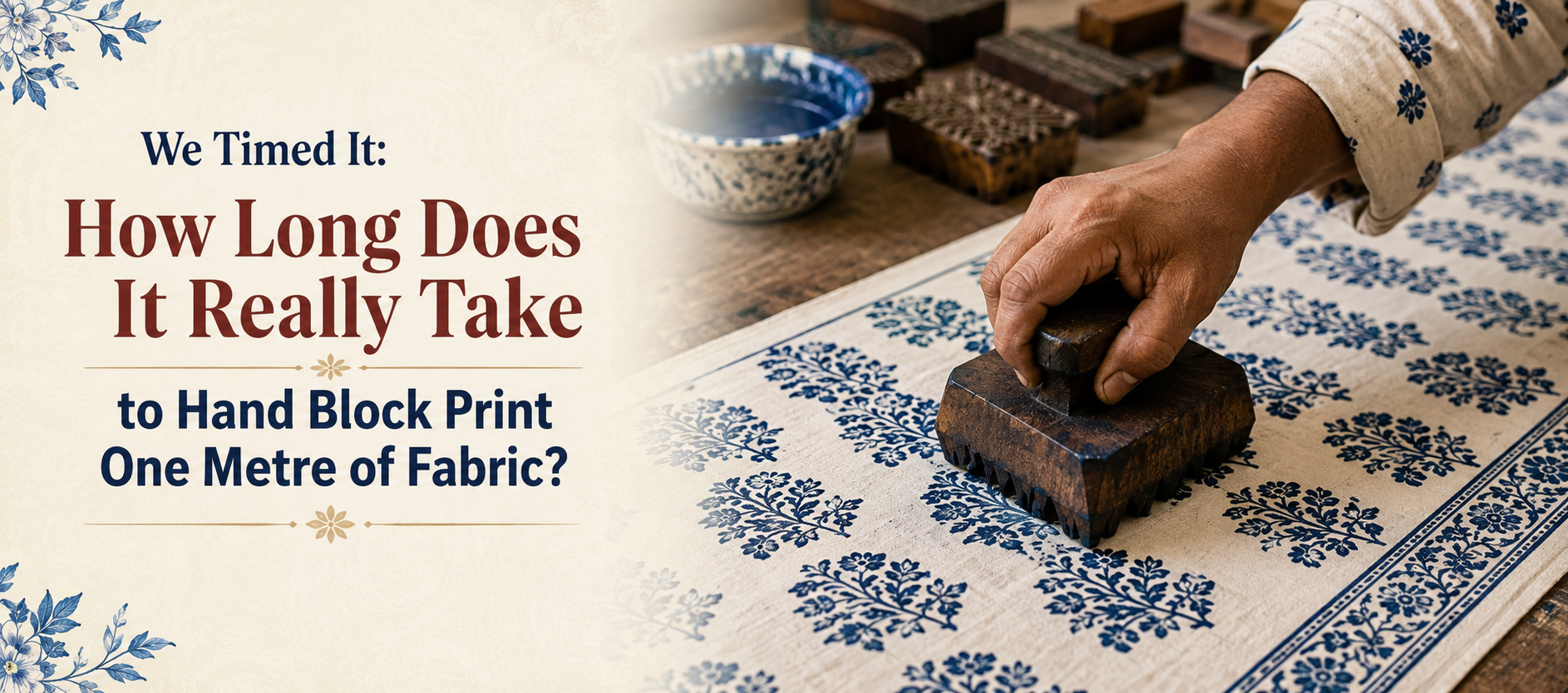
We Timed It: How Long Does It Really Take to Hand Block Print One Metre of Fabric?
A single metre of block printed cotton can pass through six distinct stages before it is ready to leave the workshop. Out of curiosity — and because customers ask us this more than almost anything else — we sat with a team of artisans in Rajasthan and timed every stage of the hand block printing process, from carved wood to finished cloth. The results explain a lot about why handcrafted textiles cost what they cost, and why no two pieces are ever quite identical.
Hand block printing is a traditional Indian textile technique in which a design is carved into a wooden block, dipped in dye, and stamped by hand onto fabric in a repeating pattern. Producing one metre of finished, multi-colour printed cotton typically takes an experienced artisan between 45 minutes and just over an hour of active stamping time alone, before drying, curing and washing are added. Most shoppers only ever see the finished cloth folded on a shelf or laid across a table, so the working hours behind it stay invisible. We wanted a real, stopwatch-checked figure rather than a rounded estimate, so we asked our artisan partners in Rajasthan to let us clock each stage as it happened, on an ordinary working day, using the same tools and dyes that go into every order.
Inside the Six Stages of Printing a Metre of Cloth
Timing a craft process is harder than it sounds, because so much of the work happens before a block ever touches fabric. To get an honest figure, we broke the work into the same six stages our artisan clusters in Jaipur and Sanganer follow for every order, and clocked each one separately.
Stage One: Carving and Preparing the Wooden Blocks
Before printing begins, a master block carver — known locally as a khatri — cuts the design into a block of seasoned teak or sheesham wood. A detailed floral or paisley motif can take between three and five days to carve by hand, though this is a one-off cost spread across thousands of metres of fabric printed from the same block over its working life. Blocks are typically soaked in oil for a week before their first use, which softens the grain and helps them absorb dye more evenly during printing.
Stage Two: Preparing and Washing the Fabric
Raw cotton arrives with natural starches and impurities still in the weave, so it is washed and sun-dried before a single stamp touches it. This preparatory wash, called degumming, takes around 20 to 30 minutes per batch and is essential for even dye absorption. It is the same groundwork stage used across our bedding lines, including the fabric that eventually becomes a block print quilts, where consistent pre-washing affects how the finished quilt handles repeated laundering at home.
Stage Three: The Stamping Process, Minute by Minute
This is the stage most people picture when they think of block printing, and the one we timed most closely. Working on a padded table, an artisan positions the block, presses it firmly onto the fabric, and lifts it cleanly to reveal one repeat of the pattern. For a simple single-colour, single-block design, an experienced printer can complete around 12 to 15 repeats per minute, which works out to roughly 20 to 25 minutes to cover one metre of standard-width cotton. Precision matters more than speed here — each stamp has to align exactly with the last, or the repeat breaks and the whole length has to be reprinted.
Stage Four: Multi-Colour Layering
Most of our designs use two, three, or occasionally four colours, and each colour requires its own carved block and a full separate pass across the fabric. A two-colour design roughly doubles the stamping time to around 40 to 50 minutes per metre, since the second block has to be aligned precisely against the first colour's outline. This layering technique is exactly what gives depth to pieces like a block print bedspread, where a base motif in one shade is often outlined or shadowed in a second, darker tone to create dimension across a large surface area.
What Actually Determines How Fast an Artisan Works
Two printers working side by side on the same design rarely finish at exactly the same time, and the gap usually comes down to three factors: years of experience, the intricacy of the motif, and how many colours the piece calls for. A printer with a decade of practice develops a rhythm — a consistent pressure and lift that keeps every repeat aligned without conscious thought — while someone newer to the craft works more slowly to avoid smudging or misaligning the pattern. Design complexity matters just as much as experience. A tight geometric repeat with small gaps between motifs demands more careful spacing than an open floral pattern, which can add several minutes per metre even for a skilled hand. Taken together, these variables are why estimating the hand block printing process in a single number is misleading; the 45-to-60-minute range we quote is an average across dozens of timed repeats, not a fixed rule.
Stage Five: Drying and Curing Under the Rajasthan Sun
Once printed, fabric cannot be handled or folded immediately, or the wet dye will smudge and blur the pattern. Freshly printed lengths are laid or hung out to air-dry, which takes roughly 30 to 40 minutes in Rajasthan's dry climate, followed by a curing period of one to three days depending on the dye type, during which colour molecules bond permanently with the cotton fibres. Natural indigo and madder dyes generally need the longest curing time, while synthetic reactive dyes set slightly faster. Weather plays a bigger role than most people expect: printing schedules are often planned around the region's dry season, since humid or overcast days can extend curing time by a further day or more, which is one reason production timelines can shift slightly between winter and monsoon months.
Stage Six: Washing and Final Finishing
After curing, the cloth is washed again to remove any excess, unfixed dye, then dried and pressed. This final wash-and-finish stage takes around 15 to 20 minutes per metre and is what stops colour from running the first time a customer washes the finished product at home. It is also the stage that determines the crispness of smaller, high-turnover items such as our block printed napkins, where a clean, non-bleeding edge matters just as much as the print itself.
Why the Time Investment Shows Up in the Finished Product
What This Timing Means for the Products You Buy
Knowing the actual clock time behind a metre of fabric changes how you look at a finished piece of homeware. A large-format item like a block print tablecloths design isn't simply "printed" — it represents hours of carving, stamping, curing and finishing compressed into a single continuous length of cloth, often two metres or more, with the pattern required to repeat flawlessly across the entire surface.
Hand Printing vs Machine Printing: Why the Time Difference Matters
Machine-printed textiles can produce the same visual pattern in seconds rather than the near hour required for hand block printing, but the two processes are not really comparable outputs. Machine printing repeats a design with mechanical perfection and no texture variation, while the slower, hand-driven method leaves faint, human traces in every repeat — the reason collectors and interior stylists in the UK increasingly seek out hand-printed textiles specifically for their imperfect, tactile character. A machine can also only reproduce a pattern it has been mechanically set up to run, whereas a skilled artisan can adjust pressure, spacing or block angle mid-batch to compensate for slight fabric irregularities — a level of on-the-spot judgement that automated printing simply doesn't need to exercise.
Small Items, Big Craftsmanship
It's tempting to assume smaller items take proportionally less time, but the setup, colour mixing and block alignment stages don't shrink much even for compact pieces. A set of block printed tote bags still requires the full sequence of carving, stamping, curing and washing per metre of fabric used, which is one reason handcrafted accessories carry the same level of detail as larger home textiles.
Understood together, these six stages show why a genuinely hand block printed metre of fabric can take anywhere from two to four days to complete from raw cloth to finished, wearable or usable textile. That time is not overhead; it is the process itself — carving, stamping, curing and finishing performed by hand, one metre at a time, exactly as it has been done in Rajasthan for centuries.
Frequently Asked Questions
How long does it take to hand block print one metre of fabric?
On average, printing one metre of fabric takes between 45 minutes and just over an hour of active stamping time for a multi-colour design. Adding fabric preparation, drying, curing and final washing, the full process from raw cotton to finished cloth typically spans two to four days in total.
Why is hand block printing so much slower than machine printing?
Machine printing uses rollers or screens that reproduce a pattern instantly and continuously, while hand block printing requires a human hand to align, press and lift a wooden block for every single repeat. This manual precision is what creates the subtle, characterful variation that machine printing cannot replicate.
Does a multi-colour block print take longer than a single-colour one?
Yes. Each additional colour requires a separate carved block and a full extra pass across the fabric, with careful alignment against the previous colour. A two-colour design typically takes close to double the time of a single-colour print of the same size.
How long do hand-carved printing blocks last?
A well-maintained teak or sheesham printing block can remain in use for years, often printing thousands of metres of fabric before the fine detail in the carving begins to wear down. Blocks are stored carefully and re-oiled periodically to keep the wood stable.
Why does hand block printed fabric sometimes have slight irregularities?
Because each stamp is placed by hand, tiny variations in pressure, alignment or ink pickup are unavoidable and are considered a mark of authenticity rather than a flaw. No two hand block printed metres of cloth are ever perfectly identical, which is part of what distinguishes genuine artisan textiles from mass-produced prints.
-
 September 18th, 2026
 -

The Art of Layering Textiles: How UK Homes Can Mix Quilts & Tablecloths
September 11th, 2026 -

Duvet vs Quilt vs Bedspread: What's the Difference and Which One Do You Need?
September 11th, 2026 -
 August 26th, 2026