
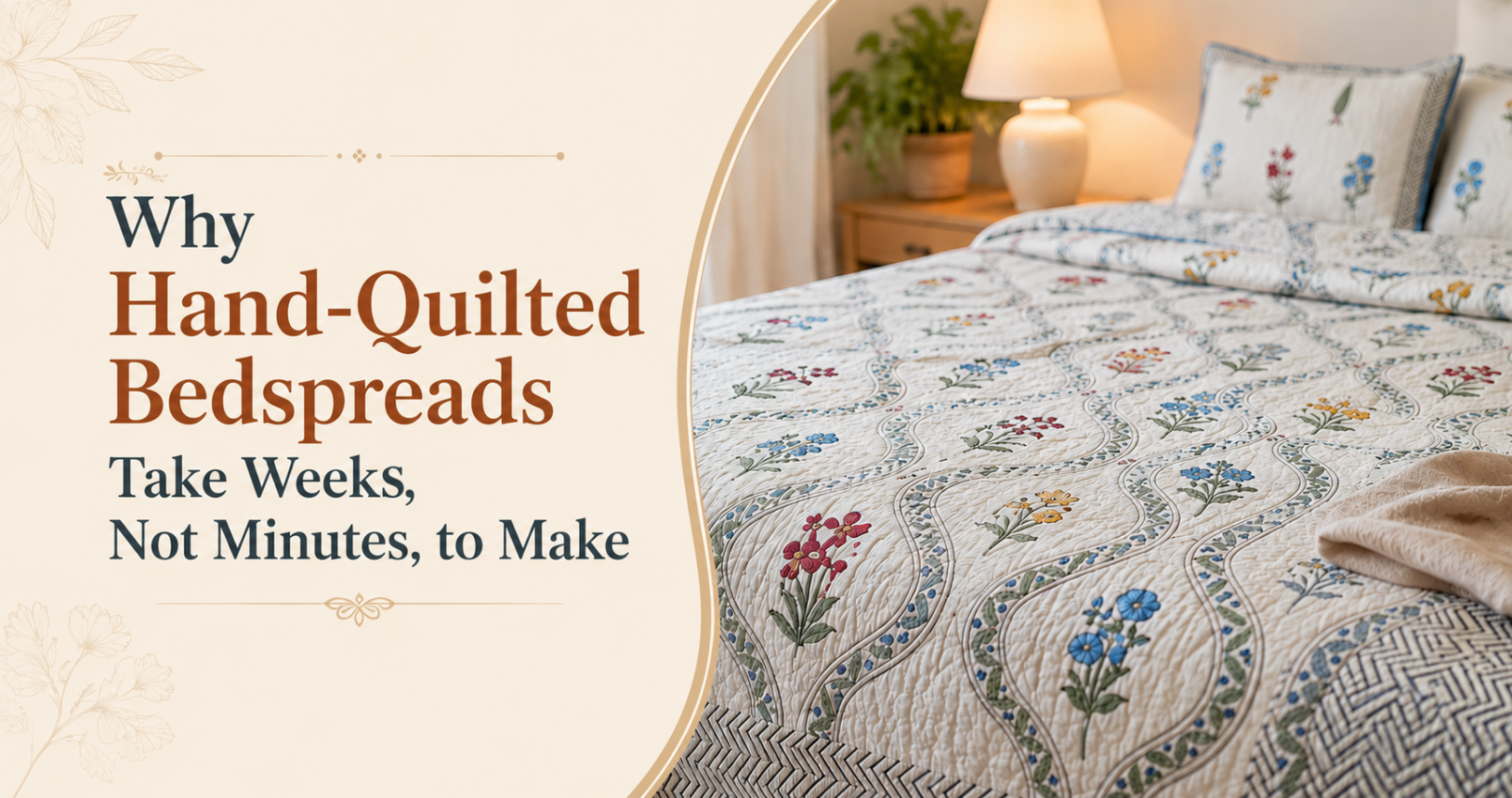
Why Hand-Quilted Bedspreads Take Weeks, Not Minutes, to Make
There is a moment, somewhere around day eleven of stitching a single bedspread, when an artisan in Jaipur sets down the needle, holds the fabric up to the light, and checks the spacing of every stitch by eye. No machine is consulted. No timer is running. This is simply how it has always been done, and it is precisely why a piece made this way outlasts almost anything bought off a shelf.
If you have ever wondered why handmade bedspreads cost more and take longer to arrive than the quilted set from a high-street homeware chain, the answer lies in a process that has barely changed in centuries. Understanding that process changes how you see the bedspread on your own bed — not as a household item, but as the result of weeks of deliberate, skilled human work.
The Hidden Timeline Behind Every Hand-Quilted Bedspread
Why "Quilted" Means Something Different in Artisan Workshops
In a factory, "quilted" usually means a machine has run a single continuous stitch line across layers of fabric in a matter of minutes. In Jaipur's artisan workshops, the word carries a far older meaning. Each line of stitching is placed by hand, one needle pass at a time, following a pattern the artisan has often learned from a parent or grandparent. There is no shortcut for this — the rhythm of hand stitching cannot be sped up without sacrificing the evenness that gives a finished bedspread its characteristic soft drape.
This is also why no two pieces are ever truly identical. Tension varies slightly from hand to hand, stitch length shifts subtly across a length of fabric, and small irregularities appear that a machine would never produce. For many shoppers, this is not a flaw to overlook but the entire point of choosing a handcrafted piece over a mass-manufactured one.
The First Stage: Selecting and Preparing the Cloth
Before a single stitch is sewn, the cotton itself has to earn its place in the workshop. Artisans inspect bolts of fabric for weave consistency and weight, because a bedspread that will be quilted by hand needs cloth that can hold tight, even stitching without puckering. The fabric is then washed and pre-shrunk, a step that protects the finished piece from warping after its first wash at home. Only once the cloth has passed this stage does it move toward printing and stitching.
Hand Block Printing: Days of Stamping Before a Single Stitch
Many handmade bedspreads from Rajasthan begin their life not with a needle but with a carved wooden block. Each motif is hand-carved into teak or sheesham wood, then dipped in natural or pigment dye and stamped onto the fabric in a careful, repeating sequence. A single large block print bedspread can require hundreds of individual block impressions, each one aligned by eye against the last. A printer working at a steady, careful pace might complete only a few metres of fabric in a day, because rushing causes motifs to drift out of alignment, an error that is immediately visible once the piece is finished.
Once printing is complete, the fabric needs time to cure. Natural dyes in particular require several days of rest and, in many workshops, a final wash to set the colour before the cloth is considered ready for the next stage.
Marking, Layering and the First Stitches
With the printed top layer ready, the artisan layers it with a soft cotton filling and a backing cloth, then marks the quilting pattern directly onto the fabric — often free-hand, using nothing more than a measuring tape and years of practised judgement. From here, the actual stitching begins, row by row, with the artisan checking tension and spacing constantly as the work progresses.
What Actually Happens Inside a Working Week
A Realistic Look at the Production Calendar
It helps to see the full picture laid out plainly, because "handmade" can sound vague until it is broken into days.
Stage | Typical Duration | What Happens |
Fabric sourcing and preparation | 1–2 days | Cotton is inspected, washed and pre-shrunk |
Hand block printing | 2–4 days | Motifs are stamped row by row using carved wooden blocks |
Dye curing and washing | 2–3 days | Colour is set and the fabric rests before stitching |
Layering and pattern marking | 1 day | Filling and backing are added; the quilting design is marked |
Hand quilting | 5–10 days | Every stitch line is sewn by hand, row by row |
Finishing, edging and quality check | 1–2 days | Edges are bound, threads trimmed, and the piece inspected |
Add it together, and a single bedspread can easily take two to three weeks from raw cotton to finished, ready-to-ship product — and that is assuming nothing needs reworking along the way, which it sometimes does.
Why Bigger Sizes Take Disproportionately Longer
It is tempting to assume a larger bedspread simply takes "a bit more" time than a smaller one, but the relationship is not linear. More surface area means more printing passes, more stitching rows, and more opportunities for the artisan to pause and check alignment across a wider span of fabric. A generously sized piece intended for a larger bed therefore does not scale up gently in production time — it can add several extra days to the schedule compared with a smaller equivalent. This is especially true for a queen size quilted bedspread, where the wider quilting span demands extra rows of careful, even stitching.
The Skill That Cannot Be Automated
Workshops have experimented over the decades with ways to speed up parts of the process, and some genuinely mechanical tasks — like cutting fabric to size — have been streamlined. But the core skills of block alignment and hand stitching have resisted automation for a simple reason: a machine can repeat a pattern, but it cannot adjust to the slight unevenness of hand-loomed cotton or correct a stitch line in real time the way a trained eye and hand can. This is the craftsmanship that buyers are paying for when they choose handcrafted textiles over mass production.
How to Recognise Genuine Hand-Quilted Craftsmanship
Look Closely at the Stitching
Genuine hand quilting rarely looks perfectly uniform under close inspection. Stitch lengths vary very slightly, and the spacing between rows may shift by a millimetre or two across the piece. Machine quilting, by contrast, is almost unnervingly consistent from corner to corner. Neither is "better" in an objective sense, but if a seller is claiming hand-quilted craftsmanship, this small variation is one of the easiest ways to confirm it.
Check the Reverse Side
The back of a hand-quilted piece often tells you more than the front. Hand stitching tends to show small, slightly irregular knots and thread tension changes on the reverse, whereas machine quilting leaves a flawlessly even bobbin line throughout. Turning a bedspread over before buying — or asking for a close-up photograph if shopping online — is a simple way to verify the claim, and it is a check worth applying whether you are browsing a printed throw or a full cotton queen bedspread.
Ask About the Block Printing Process
If a bedspread is also hand block printed, the motifs should show tiny natural variations between repeats — proof that each impression was stamped individually rather than printed in one continuous run. Perfectly identical, razor-sharp repeats across the entire fabric usually indicate screen printing rather than traditional hand block printing.
Why the Extra Time Is Worth It for UK Homes
Durability That Outlasts Fast Homeware
Cotton that has been properly sourced, washed and hand-finished tends to soften beautifully with age rather than thinning out and fraying the way many mass-produced bedspreads do after a handful of washes. For a UK household investing in bedding meant to last years rather than a single season, that slower production process translates directly into a longer useful life. If you are weighing up options for a larger bed, our bedspreads queen size collection shows this same hand-finished approach applied across a range of prints and weights.
Supporting Slow Fashion Over Fast Homeware Cycles
Choosing a piece that took two to three weeks to make, rather than minutes on an industrial line, is also a quiet vote for slower, more sustainable consumption. It supports artisan livelihoods in Jaipur and Sanganer, keeps traditional techniques like hand block printing alive for the next generation, and reduces the demand for synthetic, short-lifespan alternatives that tend to end up in landfill far sooner. For larger beds, a king size quilted bedspread made this way carries the same slow-crafted value, simply scaled to fit a bigger frame.
Building a Considered Bedroom, Not Just a Decorated One
There is also a simple aesthetic reward. A bedroom built around a few well-made, story-rich pieces tends to feel calmer and more considered than one filled with disposable, trend-driven items. A hand-quilted centrepiece pairs naturally with breathable, naturally finished layers underneath, creating a bed that feels as good as it looks.
Caring for a Hand-Quilted Bedspread So It Lasts
A little care goes a long way toward protecting weeks of skilled work. Wash on a gentle, cool cycle with a mild detergent, avoid bleach entirely, and dry in shade rather than direct sunlight to protect both the stitching and the printed colours. Ironing on a low setting, if needed, helps the fabric keep its shape without flattening the texture of the quilting. If you prefer a lighter, crisper layer beneath a heavier quilted piece, our cotton percale bedding range offers the same breathable, hand-finished quality in a finer weave.
Frequently Asked Questions
How long does it take to make a hand-quilted bedspread?
A single piece typically takes between two and three weeks from fabric preparation through to finishing, depending on size and the complexity of the printed design.
Why are hand-quilted bedspreads more expensive than machine-made ones?
The price reflects skilled labour hours, hand block printing, natural dye curing time, and the slower pace required for even, durable hand stitching throughout.
How can I tell if a bedspread is genuinely hand-quilted?
Check for slight irregularities in stitch length and spacing, an uneven bobbin line on the reverse, and small natural variations in any block-printed motifs.
Are hand-quilted cotton bedspreads suitable for everyday use in the UK?
Yes. Breathable cotton construction makes them comfortable through the British climate's shifting temperatures, and proper hand finishing helps them withstand regular washing over years of use.
How should I wash a hand block printed, hand-quilted bedspread?
Wash in cold or lukewarm water on a gentle cycle with mild detergent, avoid bleach, and dry in the shade to protect both the colours and the stitching.
-
 October 2nd, 2026
 -
 September 25th, 2026
 -
 September 18th, 2026
 -

The Art of Layering Textiles: How UK Homes Can Mix Quilts & Tablecloths
September 11th, 2026 -

Duvet vs Quilt vs Bedspread: What's the Difference and Which One Do You Need?
September 11th, 2026