
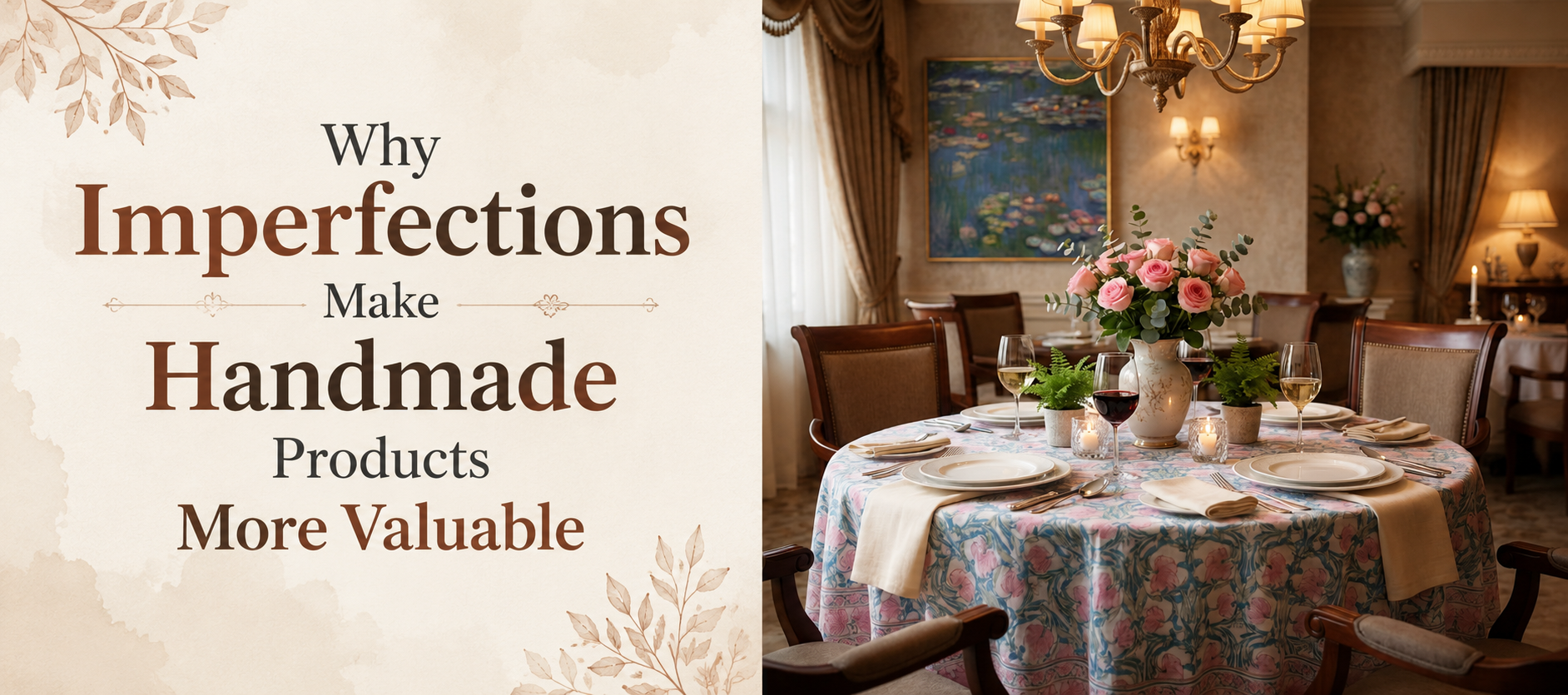
Why Imperfections Make Handmade Products More Valuable
The Beauty of the Imperfect: How Human Marks Add Value to Handcrafted Goods
There is a small moment that happens when you look closely at a genuinely handmade object. You notice a line that curves just slightly more than geometry would require, a colour that deepens fractionally at the edge of a print, a stitch that sits a hair's breadth from its neighbours. Your first instinct, if you have been trained on factory-perfect goods, might be to call this a flaw. But look again. What you are seeing is evidence of a human hand — and that changes everything about the object's meaning, its value, and its longevity in your life.
This guide explores why those small irregularities are not defects to be apologised for, but the very qualities that make handmade goods worth owning, worth paying for, and worth keeping for decades rather than seasons.
The Ancient Wisdom Behind Embracing Imperfection
The Japanese concept of wabi-sabi — finding beauty in impermanence, incompleteness, and imperfection — has been practised in craft and design for centuries. But it is not uniquely Japanese. Indian textile traditions carry an equivalent understanding. In Rajasthani block printing, it is well understood that no two impressions from the same carved block will be identical: the pressure of the artisan's hand, the quantity of dye loaded, the subtle unevenness of the cloth beneath — all of these variables produce micro-differences that accumulate across a fabric's surface into something richer and more alive than any machine-printed repeat.
Medieval European guild craftsmen held a similar belief, sometimes deliberately introducing a small asymmetry into an otherwise perfect piece to acknowledge that only the divine was truly flawless. The point was not carelessness. It was philosophical humility — and a recognition that perfect uniformity is the signature of a machine, not a maker.
What a Small Irregularity Actually Tells You About an Object
When you purchase a handmade textile, a small registration shift in a block-printed motif is communicating several things simultaneously. It tells you that a living person held the block, felt the resistance of the fabric, and made a judgement call about pressure and placement. It tells you that the pattern was built incrementally, repeat by repeat, across a surface measured in minutes and effort rather than milliseconds and mechanical precision. And it tells you that this specific object — not its design, but this physical piece — is genuinely singular. No identical copy exists anywhere in the world.
That singularity is not a marketing claim. It is a logical consequence of the production method. Two artisans working side by side with the same block, the same dye, and the same cotton will produce two cloths that are similar but not the same. This is precisely what makes them valuable in a market flooded with identically reproducible goods.
Why the Dining Table Is One of the Best Places to See This Principle at Work
One of the clearest expressions of the benefits of handmade products appears in the context of the dining table. A block print cotton tablecloth carries pattern that was laid down stamp by stamp, in a Jaipur workshop, by an artisan who has practised the same movement thousands of times. The slight variation in ink saturation from one flower to the next — lighter here, a touch deeper there — gives the cloth a visual depth that a digitally printed replica simply does not possess.
Place two tablecloths side by side, one block-printed and one digitally reproduced, and the difference is apparent in seconds. The handmade version has what designers call presence: a quality of existing in physical space rather than merely reproducing an image on a surface. That presence comes directly from its imperfections, from the evidence of the hand that made it.
Handmade Goods and the Shift Away from Disposable Consumption
There is a broader cultural argument embedded in the value of imperfection. The past decade has seen a significant rethinking of consumption patterns across the UK, driven partly by environmental awareness and partly by a growing dissatisfaction with the sameness of mass-produced goods. Slow fashion and slow home movements have emerged from this rethinking, and handmade products sit at their centre.
The logic is straightforward. A mass-produced item is designed to be replaced: its materials are chosen for cost, its appearance for trend-alignment, its lifespan for obsolescence. A handmade item is made differently, from different motivations. The artisan's time is invested in it; the materials are typically higher quality and more natural; and the result is an object that is built to outlast the season it was made in by years or decades. The imperfections it carries are not signs of inadequate quality control. They are signs of a different philosophy of making entirely.
How This Applies to Quilts and Layered Textiles
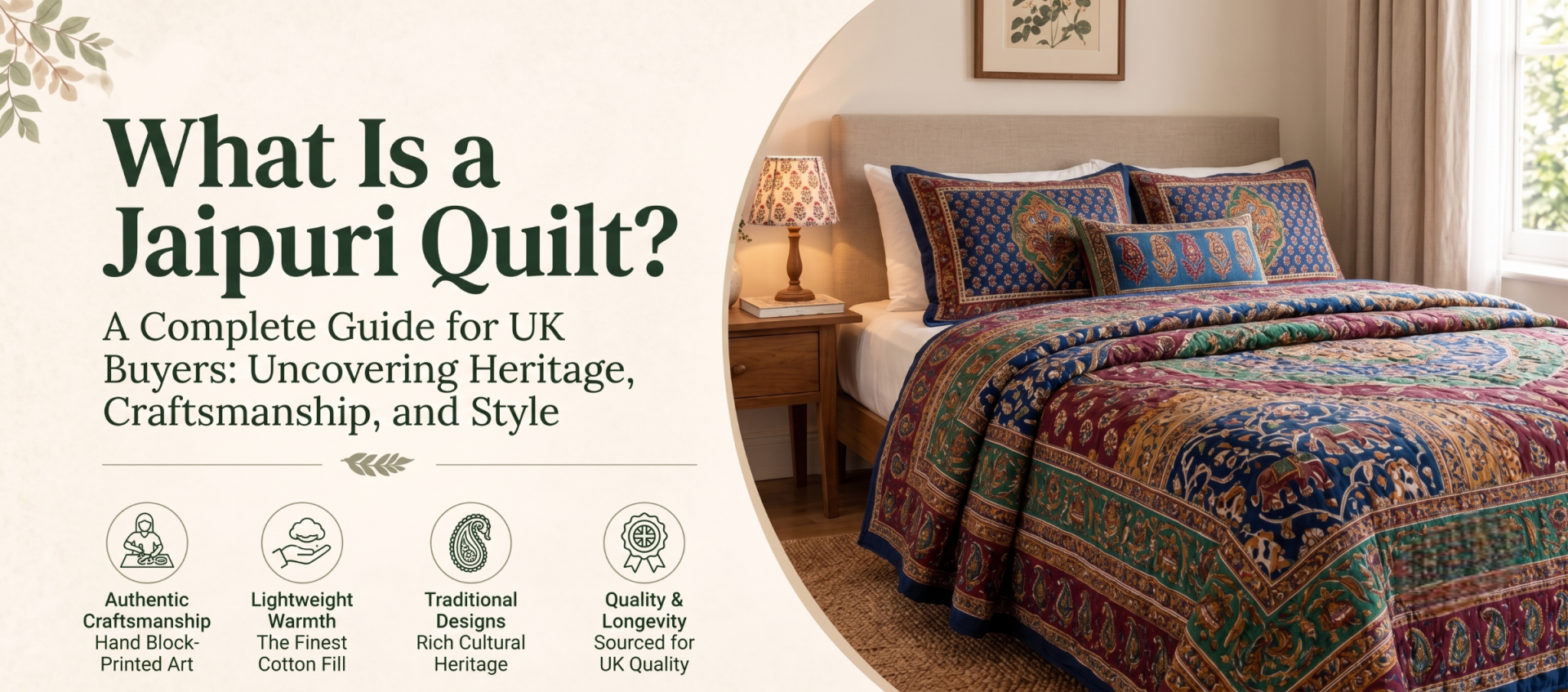
Quilts represent one of the most layered expressions of handmade value — literally and figuratively. The combination of a printed top, a natural fill, and a hand-stitched backing produces a textile that is simultaneously a functional object and a record of a person's work. When you look at cotton quilts online, the ones that carry genuine artisan provenance will show small variations in their quilting lines: the running stitch will be consistent but not robotically even, and the print beneath will carry the characteristic depth of block-printed cotton.
These details are not incidental. They are the reason the object is worth more than a machine-quilted alternative at double the thread count. Value in handmade goods is not calculated purely in materials; it includes the time, skill, and presence of the person who made it.
The Bedroom as a Space for Considered Objects
The bedroom is perhaps the domestic space where the quality of objects matters most, precisely because it is the most private and the most consistently experienced. A cotton queen bedspread made by hand brings a quality of presence to that space that machine-made alternatives cannot match. The pattern on its surface has been placed there by a person, not a printer head. The cotton has been washed, stretched, printed, and finished through a sequence of human decisions rather than automated settings.
This matters in ways that are difficult to quantify but easy to perceive. Objects made with care tend to feel different from objects made for efficiency. The handmade bedspread that sits slightly irregularly across a bed — its border print not perfectly aligned at every corner — is the one that makes a room feel inhabited and personal rather than arranged for a catalogue.
Why Small Variations Increase Rather Than Reduce Market Value
It is worth addressing the economic dimension directly, because there is still a widespread assumption that imperfection equals inferior quality and therefore lower price. The market for genuinely handmade goods tells a different story.
Collectors of studio ceramics, handwoven textiles, and artisan-made objects consistently pay premiums not despite visible human marks but because of them. The auction market for hand-printed textiles and artisan craft confirms the same principle: provenance and singularity command price, and both are guaranteed by the imperfections that prove an object's handmade status.
In the textile market specifically, the ability to point to individual variation — to say truthfully that no identical piece exists — is a powerful differentiator. It shifts the object from the commodity category, where price competition is race-to-the-bottom, into the considered-purchase category, where buyers are weighing meaning and quality alongside cost.
Carrying Something Made with Intention
The benefits of handmade products extend naturally beyond the home and into everyday accessories. Block printed tote bags are a good example of how artisan craft scales into objects designed for daily use. The bag you carry is printed with the same techniques used on bedding and dining linens — the same carved blocks, the same natural-cotton base, the same hand-laid repeat. And it carries the same micro-variations: the slight smudge at the edge of a petal, the fractional shift in a geometric repeat, the depth of dye that varies slightly from one print impression to the next.
In a world where most fabric accessories are printed by machine in quantities of thousands, a block-printed bag is visibly different. Not louder or more decorative — actually quieter and more considered. The imperfections read as restraint and intentionality rather than error.
Scale and the Human Hand: Large-Format Handmade Textiles
There is a particular admiration due to the artisan who works on very large handmade pieces. A king size quilted bedspread produced by hand requires the maker to maintain consistent quality across a very large surface — an achievement that is genuinely more impressive when you understand the process. The blocks must be loaded and applied with even pressure hundreds of times. The quilting lines must be kept regular across the full length and breadth of the piece. And yet the slight human variation that inevitably appears — the microscopic deviation in a stitching line, the fractional difference in block saturation at the edge of a print run — makes the finished object more interesting to live with than any machine-produced alternative.
Why Handmade Textiles Age Differently — and Better
One of the least discussed aspects of handmade goods is how they age. Machine-produced textiles tend to degrade in a linear way: fibres thin, colours fade uniformly, and the object moves from new towards worn without acquiring character along the way. Handmade textiles — particularly natural-cotton pieces printed with quality dyes — tend to develop rather than simply deteriorate. Queen size quilts made from natural cotton and block-printed by hand often look better after years of washing and use than they did when new. The cotton softens into itself, the dyes settle into a mellower tonality, and the stitching takes on the slightly relaxed character of a well-used object.
This is ageing with grace rather than degradation — and it is directly connected to the initial imperfections of the handmade process. A textile that began with subtle variation built into it does not look wrong when it develops further variation through use. It looks consistent with itself.
The Human Story Embedded in Every Variation
Behind every imperfection in a handmade textile is a person. The block printer who worked through a warm Jaipur morning applying repeat after repeat to a long cloth. The quilter whose stitching hand moved at a pace shaped by years of practice and by the rhythm of that particular day. The finisher who washed and dried the piece in open air rather than a processing machine.
When you own a handmade object, you own a record of that labour. Not in a sentimental or abstract sense, but in a quite literal physical one: the marks of those hours and those hands are visible in the object itself. No machine can replicate this. No digital print can contain it. It is the exclusive property of objects made by people — and it is the deepest reason why imperfection, in the handmade context, is not a flaw to be corrected but a quality to be valued.
How to Recognise Genuine Handmade Quality When You Buy
For UK buyers navigating a market that contains both genuine artisan goods and machine-made products marketed with artisan language, a few practical indicators are worth knowing. In block-printed textiles, look for slight variations in the repeat alignment — a perfectly uniform pattern across the full surface of a large cloth is more likely to be screen- or digitally-printed. Look also at the back of the fabric: hand block printing tends to show some dye penetration to the reverse, while surface printing methods often leave the back unmarked.
In quilted pieces, examine the stitching lines. Hand quilting produces lines that are consistent in overall direction but irregular in individual stitch length — the natural output of a needle driven by a human hand rather than a programmed machine. The combination of these two markers — block-printed surface with visible variation and hand-stitched quilting with human rhythm — is the clearest confirmation that the object in front of you was made by a person, not a process.
The value of that confirmation, for buyers who understand what it means, is considerable — and growing.
Frequently Asked Questions
Are imperfections in handmade textiles considered defects?
No. In genuinely handmade textiles, small irregularities — slight variations in print alignment, minor differences in stitch length, subtle tonal variation in dye — are the natural result of human production. They confirm the object's authenticity and are recognised by collectors and informed buyers as marks of quality rather than defects. A perfectly uniform handmade textile is, paradoxically, a reason for scepticism rather than confidence.
Why do handmade products tend to last longer than mass-produced alternatives?
Handmade products typically use higher-quality natural materials, because the production process depends on material performance rather than hiding variation behind uniformity. In textiles specifically, natural cotton and quality dyes age better than synthetic alternatives — softening and mellowing over time rather than degrading. The slower, more considered production process also means quality issues are identified and corrected at the point of making rather than masked by finishing treatments.
Is it possible to mass-produce something that looks handmade?
Modern printing technology can simulate the appearance of hand block printing at a surface level, but close inspection reveals the difference. Machine-simulated variation is programmatic — it follows a pattern of irregularity rather than producing genuine randomness. Authentic handmade variation is unpredictable in a way that can be felt as much as seen, particularly in the weight and texture of the material beneath the print.
How should I care for handmade cotton textiles to preserve their quality?
Wash at 30–40°C on a gentle cycle using a mild, colour-safe detergent. Avoid bleach-based products and high-temperature tumble drying, both of which accelerate colour loss in naturally dyed textiles. Line drying is preferable. Iron on a medium heat setting on the reverse of the fabric to protect printed surfaces. With this care, quality handmade cotton textiles will improve with washing rather than deteriorate.
Why are handmade products often more expensive than machine-made equivalents?
The price reflects the time, skill, and material investment of real people. A block-printed textile requires a carver to make the block, an artisan to print repeat by repeat across the cloth, and a finisher to wash and prepare the piece — all of this before any quality check or packaging. Machine production compresses these stages dramatically and reduces labour cost, but also removes the singularity and human presence that define handmade value. The premium is, in that sense, a premium for uniqueness and provenance.
-

Why Hand Block Printed Home Furnishings Are Getting Popular in the UK
October 16th, 2026 -
 October 2nd, 2026
 -
 September 25th, 2026

