

Why Natural Cotton Still Belongs on the Modern Table
In a world of fast-production synthetics and disposable home accessories, natural cotton continues to hold its ground — not by keeping up with trends, but by outlasting them. For UK households that care about how a table is set just as much as what is placed on it, the choice of tablecloth fabric is rarely an afterthought. Cotton, in its most honest, unprocessed form, offers something that no polyester blend or vinyl sheet can replicate: a surface that breathes, absorbs, softens with age, and connects the dining experience to something genuinely material and human.
This article explores why natural cotton remains a sound and considered choice for modern British homes — from the science of the fibre itself, to the artisan traditions that elevate a simple cloth into something worth keeping for years.
What Makes Cotton a Naturally Superior Fabric for the Table?
Cotton is a plant-based, cellulosic fibre — which means it behaves very differently from synthetic materials at a structural level. Its fibres are hollow, which gives them excellent breathability and moisture-wicking ability. On a table, this matters more than it might seem. Cotton absorbs condensation from cold glasses, handles a splash of wine without turning it immediately into a crisis, and regulates the microenvironment around the dining surface in a way that synthetic cloths cannot.
The softness of cotton is another characteristic that improves, rather than degrades, with repeated washing. Where polyester can pill or stiffen over time, a well-made cotton cloth becomes more supple and relaxed with every laundry cycle. It drapes more naturally, sits more comfortably across the table edge, and develops a visual character that new fabric simply does not have.
Cotton also takes dye exceptionally well. This is why block-printed and hand-dyed cotton cloths can hold such vivid, saturated colours — the fibre bonds with natural pigments at a molecular level, producing hues that remain rich and stable even with regular washing at cool temperatures.
The Case for Natural Fibres in the Age of Synthetic Alternatives
It is easy to understand the appeal of synthetic tablecloths. Polyester and vinyl options are marketed as stain-resistant, crease-free, and low-maintenance — all qualities that speak directly to the demands of busy family life. But there is a growing body of evidence, and a growing cultural shift, that calls this trade-off into question.
Polyester is derived from petroleum. It does not biodegrade in any meaningful human timeframe — estimates suggest synthetic textiles can take between 20 and 200 years to break down in landfill conditions. Every wash of a polyester cloth also releases microplastics into the water system. These are not abstract concerns; they are increasingly documented environmental costs that UK consumers are factoring into purchasing decisions.
Cotton, by contrast, is fully biodegradable. A natural cotton tablecloth that has reached the end of its useful domestic life can be composted, repurposed, or repaired — and even in landfill, it will decompose within months rather than centuries. For anyone choosing an eco friendly tablecloth for their home, cotton is not simply the natural option — it is the more accountable one.
Why the Artisan Process Changes Everything
There is a significant difference between a plain mass-produced cotton cloth and one that has passed through the hands of a skilled artisan. The latter carries a distinct visual and tactile quality — one that machine production cannot replicate — and in the case of hand block-printed textiles, it carries a living tradition as well.
Hand block printing is one of India's oldest textile arts, particularly concentrated in Jaipur and Sanganer in Rajasthan, where artisans use hand-carved wooden blocks to press intricate patterns — botanical, geometric, floral, or abstract — across fabric, repeat by repeat, with only their hands and practised eye to guide the spacing. The result is a design that is precise but not mechanical: there are slight variations in pressure and alignment that give hand block-printed cloth its unmistakable warmth and depth.
When this process is applied to tablecloths, it transforms a purely functional object into something that holds a story. The cloth on a dining table set with block print tablecloths is not an anonymous surface — it is an object of craft that enriches the meal and the room simultaneously.
Cotton Tablecloths and the Modern UK Home
The British dining table has always been a site of ritual as much as practicality — from weekday suppers to Sunday lunches and Christmas celebrations. The table linen chosen for these occasions reflects both the occasion's significance and the household's values. Cotton tablecloths sit comfortably across all of these registers: casual enough for daily use, considered enough to hold their own at formal occasions.
A well-chosen block print cotton tablecloth in a botanical or geometric print works equally well as a backdrop for a relaxed family breakfast and a more carefully laid dinner party setting. Unlike linen, which can feel imposing, or vinyl, which feels purely utilitarian, cotton occupies a middle ground — warm and textured, but also practical and approachable.
For dining tables in standard UK sizes, rectangle tablecloths in cotton are the most versatile option. They can be sized precisely to the table with a generous drop on all sides, creating a finished, deliberate look without over-formalising the setting.
Shape, Size, and the Practical Logic of Choosing Well
Selecting the right tablecloth goes beyond fabric choice. Shape, size, and weight all contribute to how a cloth performs and how a table looks. Here is a practical guide for UK dining tables:
Rectangle Dining Tables
The most common table shape in UK homes, the rectangle dining table is best served by a cloth that extends 30–40 cm beyond the table edge on all sides. For 4–6 seaters, 150 × 220 cm is the standard fit. For larger tables of 8–10 people, a 180 × 270 cm cloth is appropriate.
Round Dining Tables
A round dining table benefits from a cloth that drapes evenly in all directions, with no awkward corners. A round table cover cloth in hand block-printed cotton creates a particularly striking effect — the circular form highlights the all-over pattern in a way that a rectangle cannot, giving the table a more composed, intentional look.
Long Banquet or Kitchen Tables
For extended kitchen or dining tables — common in open-plan homes or for festive occasions — long tablecloths in natural cotton are the practical answer. They are weighty enough to stay in place, drape well over long surfaces, and maintain their appearance through lengthy meals and repeated washes.
Completing the Table: Napkins and the Layered Linen Approach
No discussion of table linen is complete without addressing the items that sit alongside the tablecloth. The growing interest in reusable, washable cloth napkins — in place of disposable paper alternatives — is one of the clearest expressions of mindful, sustainable dining in the UK. A set of block printed napkins in coordinating or complementary patterns adds depth to the table setting, tying the overall look together while reducing single-use waste.
For those interested in a layered approach to table dressing, pairing a patterned tablecloth with solid-colour napkins (or vice versa) creates a nuanced, composed aesthetic that is far more interesting than any single-material place setting. It also allows individual elements to be replaced or updated without replacing the entire linen set — which is both a cost-effective and a more sustainable approach to the table.
Sustainability and Slow Living: Cotton as a Long-Term Investment
The slow-living movement — centred on intentional, considered consumption — has particular resonance in the context of table linen. A quality cotton tablecloth is not a seasonal purchase; it is an object intended for years of use, capable of being laundered hundreds of times, repaired if necessary, and eventually composted at the end of its life.
Choosing an eco friendly tablecloth made from natural cotton, and produced through artisan rather than industrial methods, is a small but meaningful step towards a more considered domestic life. It is a choice that aligns with values — environmental responsibility, support for craft traditions, preference for quality over volume — without requiring any compromise on aesthetics or function.
When that cotton is grown using sustainable practices, printed with non-toxic natural dyes, and produced by skilled artisans earning fair wages, the cloth on your table becomes more than a domestic object. It becomes a small but concrete argument for how things ought to be made.
How to Care for a Cotton Tablecloth
Proper care extends the life of any natural textile significantly. For cotton tablecloths, particularly those with hand block-printed designs, the following practices will maintain quality over time:
- Wash on a cool cycle — 30°C or below is sufficient for most cotton tablecloths and will minimise colour fade and shrinkage.
- Avoid high-heat drying — line drying or laying flat preserves shape and prevents unnecessary stress on the fibres.
- Turn inside out before washing — this protects the printed surface and reduces friction against dyes.
- Iron while slightly damp — cotton responds well to a medium iron when still a little damp, producing a crisp, smooth finish.
- Address spills promptly — blot (do not rub) spills immediately with a clean cloth. Cotton's absorbency means it takes up liquid quickly, but prompt action prevents permanent staining.
- Store clean and dry — storing linen folded and clean prevents mildew and keeps fabric in good condition between uses.
With basic care, a good cotton tablecloth will outlast many cheaper synthetic alternatives and continue to improve in character over the years.
Closing Thoughts: A Natural Choice for a More Considered Table
There is nothing nostalgic about choosing natural cotton for the modern table. It is not a retreat from contemporary life; it is a recognition that some materials have earned their place because they work — practically, aesthetically, and ethically. Cotton breathes, absorbs, softens with age, holds pattern beautifully, and leaves no lasting environmental debt.
In an era of throwaway homeware, a cotton tablecloth made by an artisan using traditional techniques and natural dyes is a genuinely different kind of object: made slowly, made to last, and made to be part of a home for years rather than seasons. That is not a heritage proposition. It is a modern one.
Frequently Asked Questions
Is cotton a good material for tablecloths?
Yes, cotton is one of the best materials for tablecloths. It is soft, breathable, machine washable, and available in a wide range of patterns and sizes. Natural cotton tablecloths drape beautifully, absorb spills without immediately staining, and hold their colour well — making them practical for everyday use and special occasions alike.
How do I wash a cotton tablecloth without it shrinking?
To minimise shrinkage, wash your cotton tablecloth on a cool or gentle cycle (30°C or below) and avoid tumble drying on high heat. Line drying or laying flat to dry is ideal. For hand block-printed cotton, turn the cloth inside out before washing to help preserve the print and natural dyes.
Are hand block-printed cotton tablecloths eco-friendly?
Hand block-printed cotton tablecloths are among the most eco-friendly table linen options available. They are made from natural cotton fibres, printed with non-toxic dyes using wooden blocks carved by artisans, and produced without industrial machinery — significantly reducing energy consumption and chemical waste compared to mass-produced synthetic alternatives.
What size cotton tablecloth do I need for my dining table?
For a standard 4–6 seater dining table, a tablecloth measuring 150 × 220 cm works well, allowing an even 30–40 cm drop on all sides. For larger tables seating 8–10, a 180 × 270 cm cloth is suitable, and for 10–12 seaters, a 200 × 300 cm tablecloth provides full coverage. Round tables typically require a cloth with a diameter at least 60–80 cm larger than the table top.
How does a cotton tablecloth compare to polyester for everyday use?
Cotton tablecloths are a more natural, breathable, and aesthetically refined choice than polyester for everyday home dining. While polyester resists wrinkles and is highly durable, it is a petroleum-based synthetic that does not biodegrade easily. Cotton, by contrast, is biodegradable, feels softer, and improves in character with each wash — making it a more sustainable and comfortable long-term option for UK homes.
-
 September 18th, 2026
 -
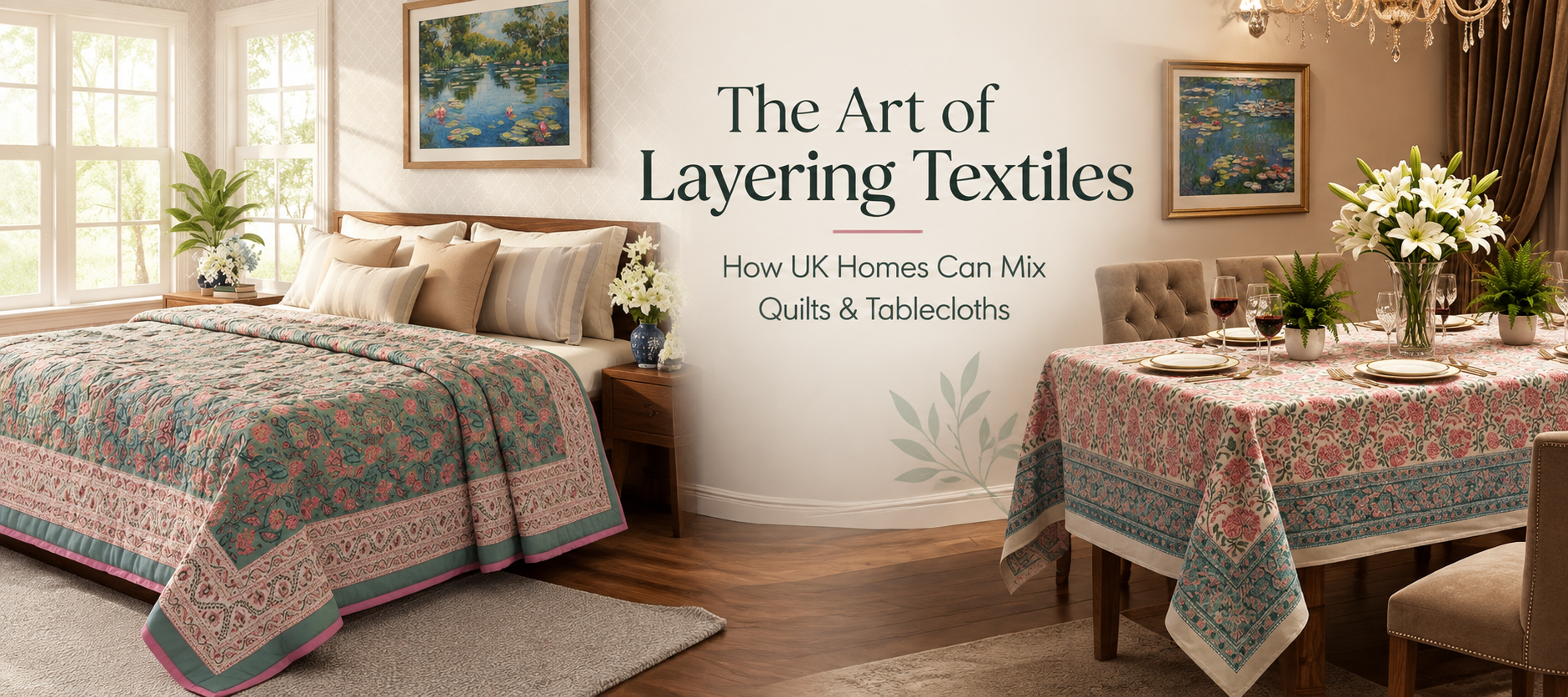
The Art of Layering Textiles: How UK Homes Can Mix Quilts & Tablecloths
September 11th, 2026 -
Duvet vs Quilt vs Bedspread: What's the Difference and Which One Do You Need?
September 11th, 2026 -
 August 26th, 2026