

Why UK Homes Are Switching to Handmade Cotton Décor in 2026
Something is changing in the way British households think about their interiors. For the past few years, a quiet but determined shift has been taking place — away from the flat, uniform surfaces of fast home furnishing and towards textiles that carry warmth, character, and a traceable story. In 2026, that shift has become a clear and growing trend. Handmade cotton home décor UK searches are on the rise, and interior enthusiasts across England, Scotland, and Wales are asking better questions before they buy: Who made this? What is it made from? Will it last?
This guide explores why that movement is happening now, what it means for the modern home, and how centuries-old Indian craft traditions — particularly from the workshops of Jaipur and Sanganer in Rajasthan — are finding a deeply appreciative audience in British living rooms, dining rooms, and bedrooms.
The Growing Appetite for Artisan Home Textiles in Britain
The UK home décor market has changed significantly since the early 2020s. The pandemic fundamentally altered how people related to their living spaces, and the years that followed brought a deeper re-evaluation of what "home" should feel like. Rooms that had previously served as functional backdrops became the central stage of daily life — and people began to want more from them.
Fast-furnishing fatigue set in. Homeowners grew increasingly aware of the environmental cost of cheap, disposable textiles: the synthetic fibres that do not biodegrade, the factory processes that consume enormous quantities of water, the supply chains that offer no transparency about how goods are made or by whom. In parallel, the slow living movement — already gaining momentum — provided a compelling alternative philosophy: fewer, better things, made with care and intended to last.
Into this cultural moment, artisan-made cotton textiles arrived with something factories simply cannot replicate: the evidence of a human hand. The gentle variation in a block print. The barely-there irregularity in a stitching line. The slight tonal shift where the dye settled differently on a fold in the fabric. These are not defects. They are the very qualities that make a piece worth owning.
How the Dining Table Became a Statement of Values
One of the most visible expressions of this shift is in the dining room. For generations, the British dining table was dressed simply — a plain cloth for formal occasions, nothing at all for everyday meals. That has changed. Homeowners are now styling their tables with intention, and textiles play a central role in that curation.
Handcrafted table linens, particularly those made using traditional Indian hand block printing, have found significant favour because they offer something mass-market alternatives cannot: genuine uniqueness. No two pieces are ever truly identical when printed by hand with carved wooden blocks and natural dyes. Each cloth tells a slightly different version of the same story — the same motif, but expressed with the individual pressure and rhythm of the artisan who made it.
For UK households seeking to bring that quality into their own homes, exploring a collection of block print tablecloths handcrafted in Jaipur is an excellent starting point. Made from 100% natural cotton and printed using centuries-old techniques, these pieces demonstrate precisely why handmade dining textiles are having such a cultural moment in British interiors.
What Is Drawing UK Buyers to Indian Textile Heritage?
There is a historical dimension to this trend that is worth understanding. Britain has a centuries-long relationship with Indian textiles — one that predates the industrial revolution and stretches back to the earliest days of trade between the two countries. Muslin from Bengal, chintz from the Coromandel Coast, block-printed cottons from Rajasthan: these fabrics shaped British domestic interiors long before synthetic alternatives existed.
In 2026, that relationship is being renewed — but on very different terms. Today's UK buyers are not simply looking for an aesthetic novelty. They are seeking out authentic craft with genuine provenance: textiles made by skilled artisans in the regions where those traditions were born, using natural materials and methods that have remained largely unchanged for hundreds of years.
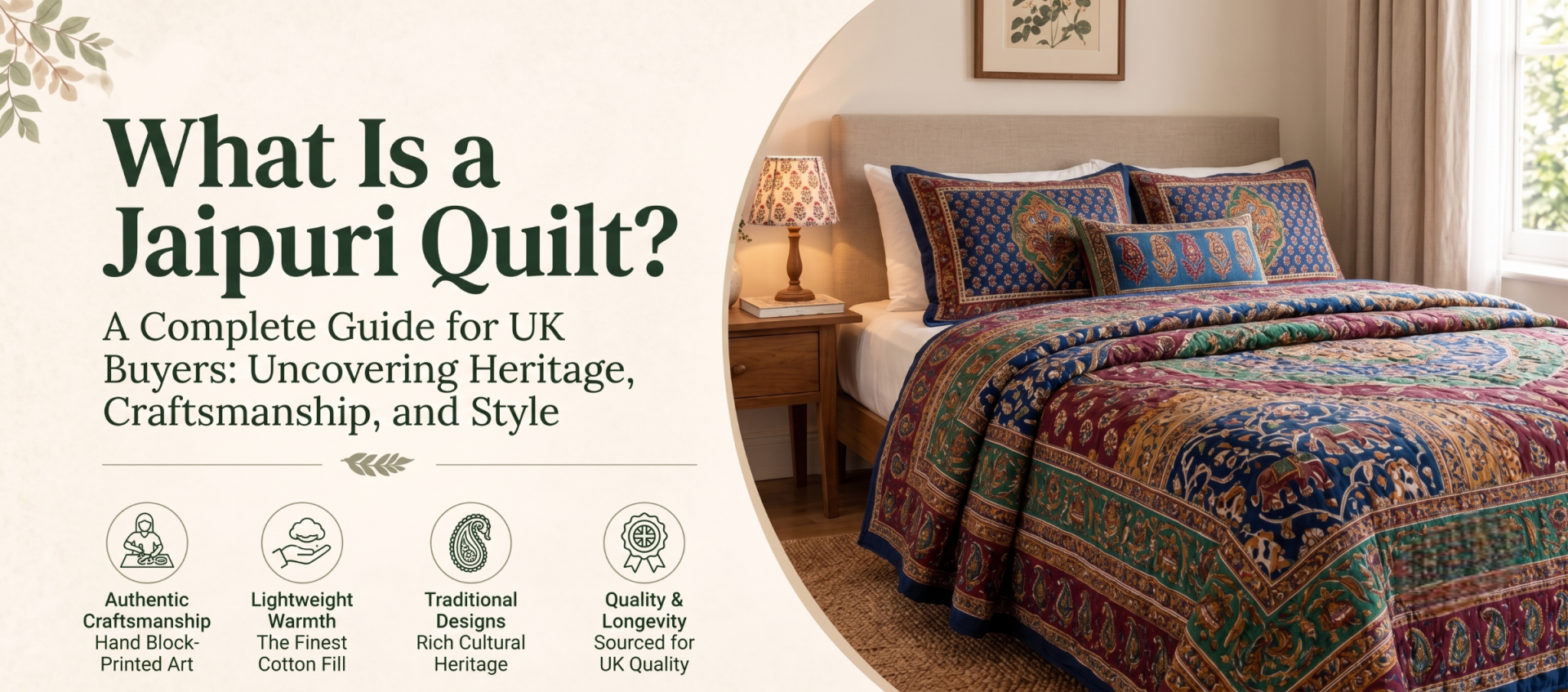
Rajasthani bedding is one of the clearest examples of this renewed interest. Indian quilts crafted in Jaipur, featuring hand block printed motifs in classic floral and geometric patterns, are finding their way into British bedrooms not as exotic imports but as considered, sustainable choices — breathable in summer, layerable in winter, and beautiful in all seasons.
What Makes Hand Block Printing Different from Digital or Screen Print?
It is a question worth asking clearly, because the answer explains much of the artisan textile movement's appeal. Screen printing and digital printing are faster, cheaper, and produce perfectly uniform results — which is precisely what they lack.
Hand block printing begins with a craftsperson carving a design into a block of Sheesham or Teak wood. That process alone can take several days for a complex motif. The printer then dips the block into dye and stamps it onto the fabric by hand, repeating the action hundreds — sometimes thousands — of times across a single piece. Each impression carries the weight of the artisan's hand, the texture of the wood grain, and the organic character of natural pigment meeting natural fibre.
The result is a cloth that you can feel, not just look at. A block print cotton tablecloth made this way has a texture and depth that digital print on polyester simply cannot achieve. UK consumers who have experienced both understand the difference immediately — and increasingly, they are choosing craft over convenience.
Why Natural Cotton Is Becoming the Fabric of Choice for UK Bedrooms
Britain's relationship with natural fibres has always been strong — wool, linen, and cotton have been bedroom staples for generations. But the trend accelerated notably when awareness around synthetic textiles grew. The realisation that polyester fleece sheds microplastics with every wash, that synthetic duvets and bedding off-gas chemicals, and that petroleum-based fibres are neither breathable nor biodegradable, sent many UK shoppers back towards natural alternatives.
Cotton, in particular, has reasserted its position as the premium bedding material. It breathes. It softens with washing. It regulates temperature across the seasons — a quality that matters considerably in Britain's variable climate. And when that cotton is also handcrafted, block printed, and quilted by artisans in Rajasthan, it carries a warmth that goes beyond the thermal.
UK shoppers increasingly looking for cotton quilts online are finding that traditional Indian quilting offers exactly the kind of quality and sustainability credentials they are seeking: 100% natural material, hand-stitched construction, no synthetic fillings, and a durability that makes the investment worthwhile over years of use.
Dressing the Bedroom with Intention: The Artisan Approach
The bedroom is where the artisan textile trend has perhaps made its most significant impact. Interior designers and homemakers alike are moving away from the coordinated-set approach — duvet cover, pillowcase, fitted sheet, all identical — and towards a layered, considered aesthetic that mixes textures, weights, and patterns with more confidence.
In this context, a well-chosen bedspread becomes the centrepiece of the room rather than an afterthought. A hand block printed cotton bedspread in a botanical or geometric motif sets the palette for the entire space — bringing colour, texture, and cultural depth into a room that might otherwise feel sterile.
For UK households making this transition, a cotton queen bedspread crafted from percale cotton and hand block printed by Jaipur artisans offers an ideal starting point. Percale cotton is woven tighter than standard cotton sheeting, giving it a crisp, cool feel that suits both the aesthetic and the practical demands of the British climate — particularly during the warmer months.
Small Pieces, Significant Impact: How Artisan Table Accessories Are Changing British Dining
Not every step into the artisan home requires a major purchase. Some of the most effective changes in a home's character come from small, considered additions — and nowhere is this truer than the dining table.
Cloth napkins represent one of the simplest and most sustainable swaps a UK household can make: replacing disposable paper with reusable cotton. But when those napkins are handcrafted, block printed by artisans in Rajasthan, and made from 100% natural cotton, they move beyond the functional into the genuinely beautiful. They become part of the table's story — something guests notice and ask about.
The rise in interest around block printed napkins reflects a broader shift in how UK households approach the ritual of eating together. The table is no longer dressed for special occasions alone. It is set with care every day — and the textiles used to dress it are chosen with the same attention to craft and provenance that consumers now apply to the food they serve on it.
Sustainability Is No Longer a Niche Preference — It Is the Standard
Perhaps the most significant driver of the artisan textile trend in the UK is the mainstream adoption of sustainability as a purchasing criterion. What was once the preserve of a committed few has become a standard expectation across a wide segment of British consumers. In the home décor category, this means asking questions that would have seemed unusual a decade ago: Is this made from natural materials? How far did it travel? Who made it, and under what conditions?
Handmade cotton home décor UK buyers are finding that Indian artisan textiles answer those questions convincingly. Natural cotton is biodegradable. Hand block printing uses minimal energy compared to industrial printing processes. The craft clusters of Rajasthan — many of them family businesses — represent the kind of ethical supply chain that conscious consumers are seeking out. When you buy a hand block printed cotton quilt or tablecloth from an artisan community in Jaipur, you are not simply purchasing a home textile. You are participating in the preservation of a centuries-old tradition that supports livelihoods, retains cultural knowledge, and produces something the world would be genuinely poorer without.
How to Bring Artisan Cotton Textiles into Your Home Without Overwhelming a Space
One of the most common questions people have when first exploring handcrafted Indian textiles is how to incorporate them without the result feeling overly themed or busy. The answer lies in restraint and contrast.
Start with one statement piece per room. In the bedroom, that might be a block printed bedspread layered over neutral cotton sheets. In the dining room, it could be a hand block printed tablecloth in an indigo or terracotta palette, paired with simple ceramic tableware. Let the crafted piece carry the visual weight of the room, and keep surrounding elements understated.
Texture mixing is equally important. The gentle irregularity of a hand block print looks most compelling when placed alongside clean, smooth surfaces — bare wood, plain linen, unpainted plaster. The contrast amplifies what makes the handmade piece special, rather than competing with it. Over time, as the cotton softens with washing and the colours settle into their most beautiful register, these pieces become permanent features of a home's identity rather than seasonal additions.
A Final Thought: Choosing Craft in a World of Convenience
The trend towards handmade cotton home textiles in UK homes is not, at its heart, about aesthetics alone — though the beauty of a hand block printed cloth is undeniable. It is about a recalibration of values. A growing number of British households are choosing to slow down their purchasing decisions, invest in quality over volume, and bring into their homes objects that carry meaning beyond their price tag.
In that context, the artisans of Jaipur and the centuries-old textile heritage of Rajasthan are not simply suppliers of a product. They are partners in a different kind of consumption — one that places craft, care, and longevity at its centre. For UK homeowners making that shift in 2026, artisan-crafted cotton textiles are not a trend to follow. They are a standard to set.
Frequently Asked Questions
Why is handmade cotton home décor becoming popular in UK homes?
Handmade cotton home décor is growing in popularity across UK homes because it combines sustainability, natural comfort, and authentic artisan craftsmanship. Shoppers are moving away from mass-produced textiles and choosing pieces with provenance, story, and ethical production behind them — particularly those crafted using traditional techniques such as hand block printing from India.
Are handmade cotton products a sustainable choice for the home?
Yes. Handmade cotton products are among the most sustainable options available for home décor. Natural cotton fibres are biodegradable, and traditional hand block printing uses far less energy and water than industrial textile manufacturing. Choosing artisan-made cotton goods also supports small craft communities and reduces dependence on mass-produced, synthetic alternatives.
What is the difference between handmade and mass-produced home textiles?
Handmade textiles are crafted by skilled artisans using traditional processes such as hand block printing, resulting in unique patterns and gentle irregularities that reflect human craftsmanship. Mass-produced textiles are made by machines, producing identical, uniform pieces at high speed with little attention to material origin or maker welfare. Handmade pieces typically offer higher quality, greater longevity, and a personal story.
Which rooms benefit most from handmade cotton textiles?
Every room in the home can benefit from handmade cotton textiles. In the bedroom, hand block printed quilts and bedspreads introduce warmth and character. In the dining room, printed tablecloths and napkins elevate everyday meals. Living spaces gain texture and colour through cushion covers and throws, while kitchens are enhanced by artisan tea towels and oven mitts crafted from natural cotton.
How do I care for handmade cotton home textiles?
Handmade cotton textiles should be washed on a gentle or delicate machine cycle using cold water and a mild detergent. Avoid bleach and harsh chemicals, which can fade hand-printed colours. Air drying in the shade rather than tumble drying helps preserve fabric quality and print vibrancy. With proper care, quality handmade cotton pieces retain their character and colour for many years.
-

Why Hand Block Printed Home Furnishings Are Getting Popular in the UK
October 16th, 2026 -
 October 2nd, 2026
 -
 September 25th, 2026
 -
 September 18th, 2026
