
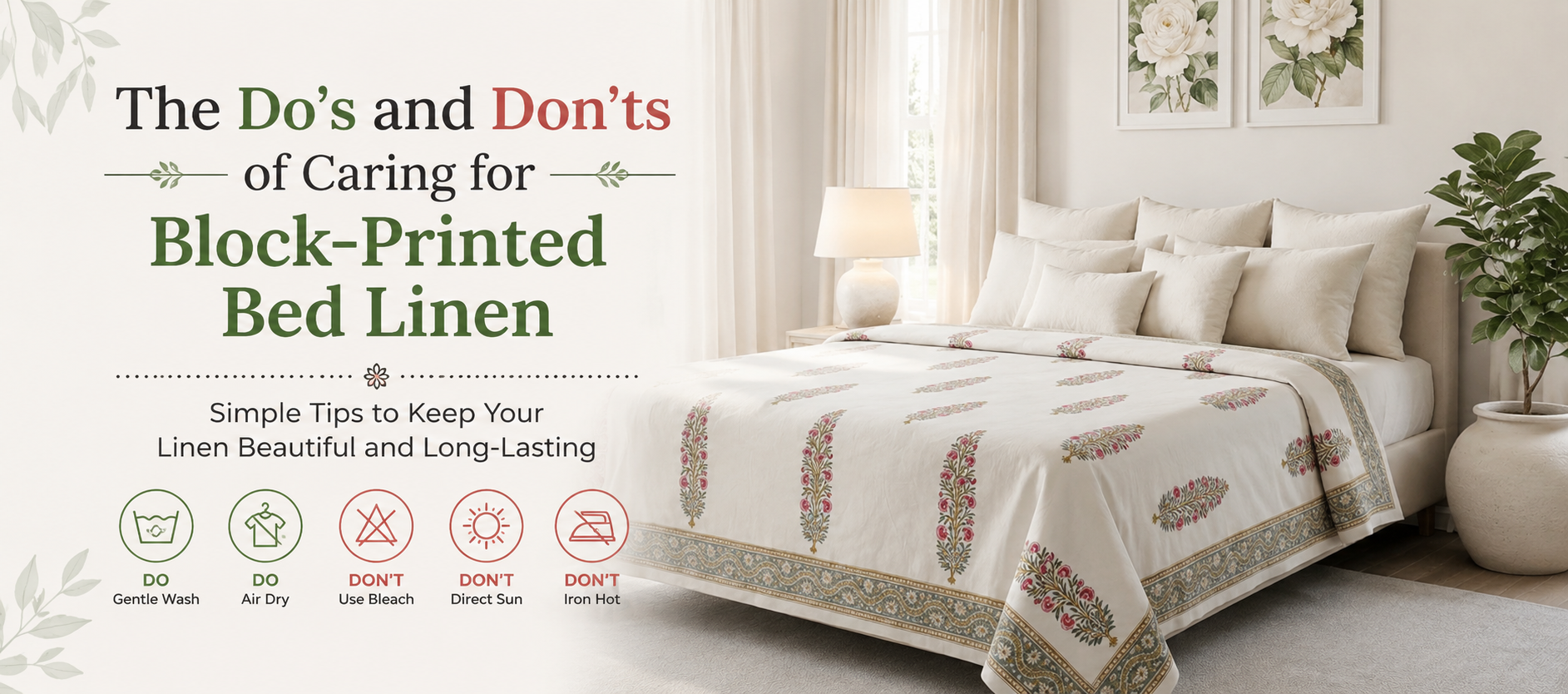
The Do's and Don'ts of Caring for Block-Printed Bed Linen at Home
Block-printed bed linen is more than a bedroom accessory — it is a living piece of craft. Each motif on your handprinted cotton sheet or quilt was carved into a wooden block by a skilled artisan in Rajasthan, pressed by hand, and dyed using techniques passed down through generations.
That heritage deserves more than a hot wash and a tumble dry. Whether you own a richly patterned block print bedspread, a lightweight dohar, or a Kantha quilt, knowing exactly how to wash, dry, iron, and store it will protect both the colours and the craftsmanship for years to come.
Why Block-Printed Textiles Need Special Attention
Unlike factory-printed fabrics that use chemical fixatives and synthetic dyes baked at high temperatures, authentic hand block printing relies on natural or reactive dyes that bond gently with cotton fibres. The result is a beautifully muted, organic colour palette — but one that responds differently to heat, harsh detergents, and mechanical stress than mass-produced bedding.
Natural cotton itself is wonderfully breathable and kind to skin, making it perfect for the variable British climate. However, the combination of natural fibres and artisan dyes means that everyday laundry habits — boil washes, biological detergents, or tumble drying on high — can strip colour, distort prints, and weaken the fabric structure prematurely.
These block printed bedding care tips are designed to help you avoid the most common mistakes while keeping your bedding looking as beautiful as the day it arrived.
Think of block-printed cotton the way you think of a silk blouse or a hand-dyed rug. It is not fragile, but it rewards a little considered care. A few small adjustments to your laundry routine will make the difference between colours that fade within a year and prints that stay vivid for a decade.
How to Wash Block-Printed Bed Linen Correctly
Always Start With a Cold or Cool Wash
Heat is the single biggest enemy of natural dyes. Water above 40°C causes cotton fibres to contract suddenly, which physically dislodges dye molecules from the fabric surface.
For block-printed linen, a 30°C gentle cycle (or a cold hand wash) is ideal. The cooler temperature maintains colour integrity and prevents shrinkage — particularly important for larger pieces such as a queen size quilted bedspread that covers a significant surface area.
Choose the Right Detergent
Biological detergents contain enzymes that are excellent at breaking down protein stains — but those same enzymes attack natural dyes and plant-based fibres.
Always opt for a mild, non-biological, or colour-safe detergent. Even better, a gentle liquid detergent formulated for delicate fabrics minimises mechanical agitation during the wash.
Avoid anything labelled "stain-blast," "ultra-clean," or "whitening," as these almost certainly contain optical brighteners or bleaching agents that are devastating for coloured prints.
Turn It Inside Out — Every Single Time
This is one of the simplest yet most effective block printed bedding care tips, and it is almost universally ignored.
Turning the linen inside out before placing it in the machine means the printed surface faces inward, away from the drum's friction. It takes five seconds and can extend the vibrancy of the print significantly.
The same principle applies when hand washing — keep the printed side facing inward and work gently with your palms rather than scrubbing.
✓ Do This
Use a Mesh Laundry Bag
Placing your block-printed linen inside a mesh bag reduces friction against other items in the drum, protecting printed motifs from abrasion and snagging.
✗ Avoid This
Washing With Heavy Denim or Towels
The weight and rough texture of these fabrics acts like sandpaper against delicate cotton prints during the spin cycle. Always wash block-printed pieces separately or with similarly light items.
✓ Do This
A White Vinegar Rinse Occasionally
Add 120ml of white vinegar to the final rinse cycle once every few washes. It acts as a natural colour fixative, removes detergent residue, and leaves cotton feeling soft — without any vinegar smell once dry.
✗ Avoid This
Chlorine Bleach — Ever
Even diluted bleach will immediately oxidise and destroy natural dyes, leaving irreversible pale patches. If you need to brighten whites, use oxygen-based bleach on plain cotton sections only, and never on printed areas.
The Right Way to Dry Handcrafted Cotton Bedding
Air Drying Is Always Preferable
In the UK, an airing cupboard or an indoor clothes horse is your best friend for block-printed textiles. Lay the linen flat or hang it loosely on a drying rack in indirect light.
Direct sunlight will bleach natural dyes faster than almost anything else, so while outdoor line drying in British weather is rarely a concern, if you do manage a sunny day, choose a shaded spot or bring the linen in as soon as it is dry.
Tumble Drying: If You Must, Keep It Low and Brief
Not everyone has the space or patience to air dry large pieces like a king size quilted bedspread. If you use a tumble dryer, set it to the lowest heat or the delicate setting, and remove the linen while it is still slightly damp — about 80% dry.
Allow it to finish air drying flat. This approach prevents the fibres from over-contracting under heat, reduces static, and keeps the print surface looking smooth rather than rough and pilled.
✓ Do This
Reshape While Damp
Cotton shifts slightly in the wash. While the linen is still damp, gently pull it back to its original shape — especially around the edges and corners — before laying it flat to dry.
✗ Avoid This
Wringing or Twisting
Twisting damp cotton stretches the weave structure and can distort the position of block-printed motifs. Instead, fold the piece and gently press out excess water by hand or roll it in a clean towel.
Ironing Block-Printed Linen Without Damaging the Print
Many people assume block-printed cotton should never be ironed, but that is not quite true. The rule is simply never to iron directly over the printed side with high heat.
The correct technique is to iron the fabric while it is slightly damp, on the reverse (non-printed) side, using a medium setting — equivalent to the "cotton" mark on most UK irons, but with the steam function on rather than dry heat.
If you prefer to iron the front-facing side (for example, to smooth the edges or borders of a bedspreads queen size piece), place a thin, clean cotton pressing cloth or a tea towel between the iron and the fabric.
This distributes heat evenly and prevents the iron's soleplate from leaving shiny marks or distorting individual print motifs.
1 Iron the linen inside out or with a pressing cloth on the print side.
2 Keep the iron moving — never let it sit static on one area, especially over a dense print.
3 Use medium heat (around 150°C) with steam; avoid high-dry settings that scorch cotton fibres.
4 For light creases, a fabric steamer held at a distance is gentler and very effective on cotton.
5 Fold neatly immediately after ironing to prevent new creases from setting in overnight.
How to Handle Stains on Block-Printed Fabric
Act Quickly, But Gently
Speed matters with stains on cotton, but technique matters more. The instinct to scrub a stain vigorously can push the stain deeper into the weave and physically abrade the printed layer.
Instead, blot — never rub — using a clean white cloth dampened with cold water. Work from the outer edge of the stain inward to prevent it spreading.
Safe Stain Treatments for Natural Dyes
For food or drink stains, a paste of baking soda and cold water applied gently and left for 15–20 minutes before rinsing is surprisingly effective and completely safe for natural dyes.
A small amount of mild dish soap (non-fragranced) dabbed with a cloth also works well on oily stains. Always rinse thoroughly with cold water afterwards to remove all residue.
Avoid commercial stain removers unless the label explicitly states they are safe for coloured and delicate fabrics. Most "pre-treatment sprays" contain surfactants and solvents that lift both the stain and the dye simultaneously.
Storing Block-Printed Bed Linen Between Seasons
Clean Before You Store
This is non-negotiable. Never store block-printed linen that has been used but not washed.
Even invisible traces of body oils, sweat, or light soiling can oxidise over weeks in storage, resulting in dull yellow stains that are difficult to remove and can permanently alter the appearance of the print.
Always wash and thoroughly dry your linen before putting it away.
Breathable Storage Over Plastic Bags
Plastic storage bags trap moisture and create an environment where mildew can develop — particularly problematic in British homes with variable humidity levels.
Use breathable cotton storage bags, old pillowcases, or acid-free tissue paper wrapping instead. These allow a small amount of air circulation while protecting the fabric from dust and light.
✓ Do This
Add a Lavender Sachet
Natural lavender sachets deter moths and other textile pests without chemicals, and leave your linen smelling wonderfully fresh. Replace sachets every season for best effect.
✗ Avoid This
Mothballs or Chemical Repellents
The harsh chemicals in traditional mothballs can leave residues that discolour natural dyes over time. Natural cedar balls or lavender are far safer choices for handcrafted textiles.
✓ Do This
Refold Periodically
If storing for more than a month, refold along different lines every four to six weeks. This prevents permanent crease marks from forming in the cotton fabric at the same point repeatedly.
✗ Avoid This
Storing in Direct Light or a Damp Space
Light fades natural dyes even through windows, and damp environments encourage mildew growth on cotton. Choose a cool, dark, dry drawer or shelf — an airing cupboard with good ventilation is ideal.
Extending the Life of Your Handcrafted Bedding
Rotate Your Bedding Regularly
If you own multiple pieces — for example, a cotton queen bedspread for everyday use and a lighter dohar for warmer months — rotating them evenly distributes wear and reduces the frequency with which each piece needs to be washed.
Less washing means less stress on the fibres and dyes, which directly translates to a longer useful life.
Understand That Some Softening Is Natural and Beautiful
High-quality block-printed cotton does not fade and deteriorate — it matures. The colours settle and soften slightly with each wash, developing what textile enthusiasts call a "lived-in" warmth that cannot be replicated by a new piece.
This is a hallmark of authentic, naturally dyed artisan textiles. Your job is not to keep the print looking brand new forever; it is to slow the ageing process so that it happens gracefully rather than abruptly.
The First Wash: A Critical Moment
The very first wash sets the tone for all future care. Before using any new block-printed linen for the first time, wash it separately in cold water to remove any excess surface dye.
Some colour bleed on the first wash is entirely normal with authentic hand-blocked textiles and should not be a cause for alarm — it is simply the unfixed surface dye releasing.
After this initial wash, subsequent colour bleed should be minimal to none.
Quick-Reference: Block Printed Bedding Care Tips at a Glance
For those who prefer a fast summary before laundry day, here are the essential block printed bedding care tips condensed into one place:
✓ Wash at 30°C on a gentle cycle, or hand wash in cool water.
✓ Turn inside out before every wash to protect the print surface.
✓ Use mild, non-biological detergent — no brighteners, no bleach.
✓ Air dry in indirect light or tumble dry on the lowest setting.
✓ Iron inside out or use a pressing cloth — never iron directly over print motifs on high heat.
✓ Store clean, dry, and folded in breathable fabric or tissue — not sealed plastic bags.
✓ Blot, never scrub fresh stains with cold water and a clean white cloth.
✗ Never use chlorine bleach or aggressive stain-removal sprays on printed areas.
✗ Never wring or twist the fabric to remove water.
✗ Never store in direct light or a damp environment.
Final Thoughts: Caring for Craft Means Caring for Culture
Block-printed bed linen is not simply fabric — it is the product of hundreds of years of Indian artisan tradition, carried forward by skilled craftspeople in Jaipur and across Rajasthan. Every wooden block, every press of the hand, every repeat pattern tells a story that stretches far beyond your bedroom walls.
Caring for these textiles properly is a small but meaningful act of respect for that tradition. It is also, quite practically, the best investment you can make in something beautiful that you use every single night.
With the right washing habits, thoughtful drying, careful storage, and a little patience with stains, a well-made block-printed quilt or bedspread can serve you beautifully for ten years and beyond — growing more characterful and comforting with every season.
At Roopantaran, every piece we craft for homes across the UK is made with care by skilled artisans who pour genuine craft into their work. We hope these guidelines help you honour that same spirit every time you fold your linen, prepare your bed, or simply appreciate the patterns that a human hand — not a machine — pressed into the cloth just for you.
Frequently Asked Questions
1. Can block-printed bed linen be machine washed?
Yes, but always use a gentle or delicate cycle with cold or lukewarm water (30°C maximum). Turn the linen inside out before washing to protect the printed surface, and use a mild, colour-safe detergent.
Avoid washing with rough fabrics that could cause abrasion.
2. How do I stop block-printed colours from fading?
Wash in cold water, avoid direct prolonged sunlight when drying, skip chlorine bleach entirely, and use a colour-fixing rinse (like white vinegar diluted in water) occasionally.
Storing in a cool, dry place away from direct light also helps preserve dye vibrancy over the long term.
3. Is it safe to tumble dry block-printed cotton bedding?
It is best to air dry block-printed cotton bedding in indirect sunlight or indoors. If you must use a tumble dryer, use the lowest heat setting for a short cycle and remove the linen while slightly damp to prevent shrinkage and colour damage.
4. How often should I wash my block-printed bed linen?
For regular use, washing once every one to two weeks is sufficient and hygienic. Washing too frequently with harsh conditions can degrade the natural dyes over time, so stick to gentle methods whenever you do wash.
5. What is the best way to iron block-printed bed linen?
Always iron block-printed linen on the reverse side (inside out) using a medium heat setting. Place a thin cotton cloth between the iron and the fabric for extra protection.
Avoid ironing directly over printed motifs, as high heat can distort or fade the natural dyes.
-

How to Style Block Printed Accessories with Everyday Outfits
August 21st, 2026 -

Buying Less, Choosing Better: A Different Way to Think About Bedding
August 20th, 2026 -

Why Some Bedrooms Feel Like a Retreat and Others Just Feel Like a Room
August 20th, 2026 -

How to Mix Indian Block Prints with Scandinavian Interior Design
August 14th, 2026 -

What Makes a Textile "Handmade"? A Look Inside Our Jaipur Workshop
August 13th, 2026