
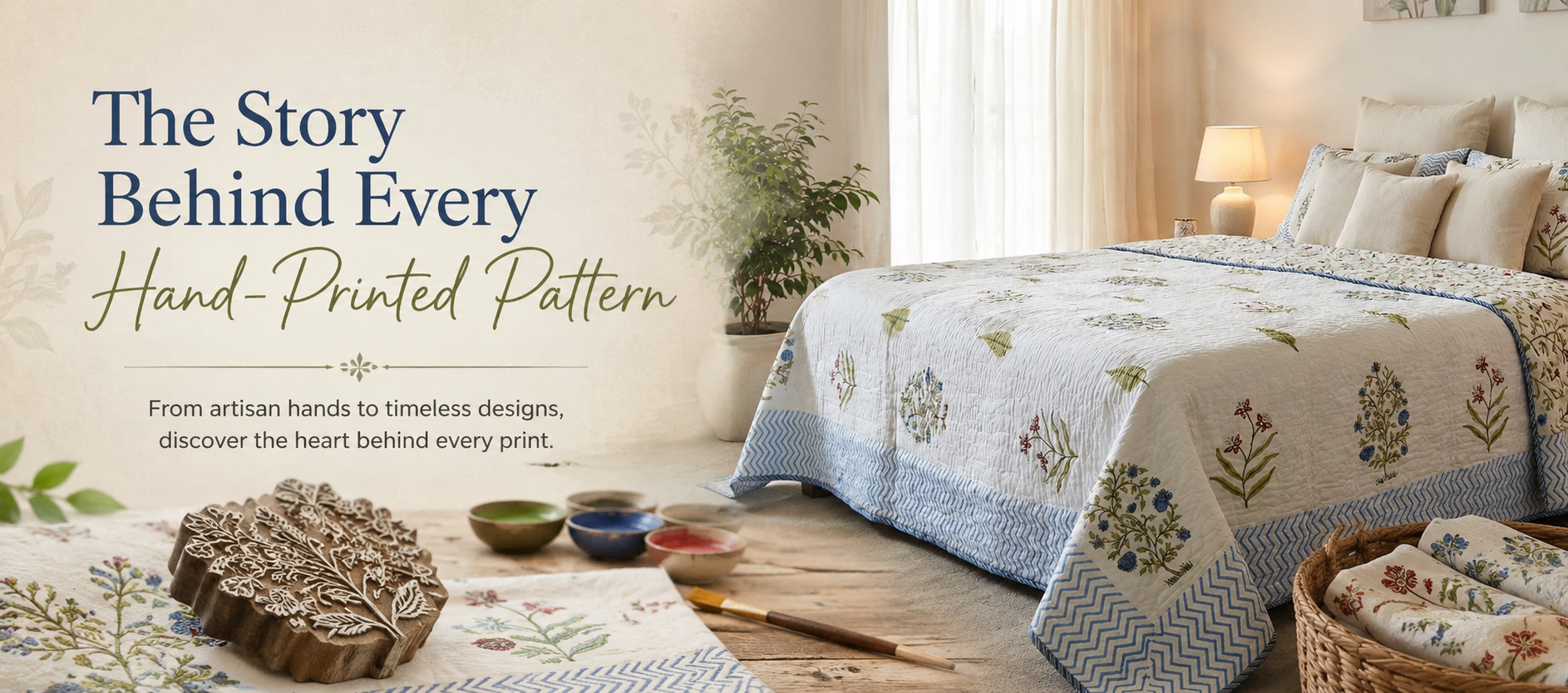
The Story Behind Every Hand-Printed Pattern
A Craft Carried by Hand, Not by Machine
Long before a textile reaches a British bedroom or dining table, it begins somewhere far quieter: a workshop in Rajasthan, a wooden block resting in a craftsman's palm, a tray of dye warmed by the desert sun. Every hand-printed pattern carries that beginning with it. It is not simply a design pressed onto cotton — it is a record of decisions, skills, and small human imperfections that no machine has ever managed to replicate. Understanding where a pattern comes from changes how you see the fabric itself.
This is the story of Indian hand block printing — a craft that has shaped how Indian textiles look, feel, and age for centuries, and one that quietly continues inside every quilt, bedspread, and tablecloth made the traditional way.
Where Every Pattern Begins: The Origins of the Craft
Block printing did not originate in India, though India is where it found its most enduring expression. Historians trace early forms of the technique back thousands of years to East Asia, but it was in the Indian subcontinent — and particularly Rajasthan and Gujarat — that the craft was refined into something distinct. Archaeological evidence from the Indus Valley civilisation points to dyeing and printing practices reaching back millennia, and the trade routes of the medieval period carried Indian printed cottons as far as Europe and Southeast Asia.
Jaipur became central to this story for practical reasons as much as artistic ones. The region's mineral-rich groundwater suited the fixing of natural dyes, while the dry climate was ideal for sun-drying freshly printed cloth. Generations of artisan families settled around the old city, and what began as a regional trade gradually became one of India's most recognised textile traditions — eventually earning Geographical Indication status for towns such as Bagru and Sanganer in recognition of their distinct, place-rooted techniques.
The Craftsman's Hands: Carving a Block Before a Single Print Is Made
Before any fabric is touched, the pattern exists only as a carving. Skilled block carvers, often working from sheesham or teak wood, spend days — sometimes weeks — chiselling a single design by hand. Every petal, vine, or geometric line is cut freehand, guided by years of trained eye and muscle memory rather than a printed template.
A single motif may require two, three, or even four separate blocks, each holding one colour or outline that will later be layered onto the fabric in sequence. This is part of why authentic hand-printed textiles often display a softness in their patterns that mass-manufactured prints lack: each layer is placed by a human hand, and no two placements are ever mechanically identical.
Natural Dyes and the Colours That Took Centuries to Perfect
Colour in traditional block printing comes from the earth itself. Indigo produces the deep blues seen across so many Rajasthani textiles. Madder root yields warm reds and pinks. Turmeric, pomegranate rind, and iron-rust solutions contribute yellows, blacks, and ochres. Mordants — substances that help dye bind permanently to cotton fibre — are prepared using techniques passed down within artisan families rather than written down in any manual.
This dye preparation is slow and deliberate. Cotton must be washed, often soaked in substances like myrobalan to prepare the fibre to accept colour evenly, then printed, dried, and sometimes washed again before the final pattern is complete. The same cotton sheeting fabric used in many of these traditional pieces — including a simple, everyday cotton queen bedspread — goes through this exact dyeing journey, which is one reason genuine hand-printed fabric carries a different weight, both literally and in the story behind it, compared to anything produced on an industrial press.
Bagru, Sanganer and the Many Dialects of Block Printing
Just as no two regions of India speak in quite the same accent, no two block-printing towns produce quite the same pattern language. Bagru is known for its earthy, mud-resist Dabu technique, producing soft, lived-in tones of indigo, black, and rust. Sanganer, closer to Jaipur itself, became known from the sixteenth century onward for finer, more delicate floral motifs printed on a lighter background, often using a direct-printing method rather than resist-dyeing.
Further west, Gujarat's Ajrakh tradition introduced sharper geometry and deeply layered colour, built through repeated printing and dyeing stages. Each of these regional styles developed in response to local water, local plants, and local taste — meaning a single craft produced an entire family of distinct visual traditions, each still recognisable today by those who know what to look for. It is also why a single block print bedspread can look entirely different from the next, depending on which workshop and which regional tradition it came from.
What the Patterns Are Actually Saying: Reading Motifs Like a Language
Many of the motifs found on traditional textiles are not decorative by accident — they carry meaning rooted in nature, daily life, and regional folklore. The buta, a paisley-like teardrop shape, is thought to represent a sprouting seed or growing plant, a symbol of life and fertility found across South Asian design for centuries. Booti, small repeating floral sprigs, often reflect the gardens and flowering trees surrounding Rajasthani villages. Jaal, the dense interlocking trellis pattern, mimics the latticed stone screens — or jaalis — found in Rajasthani architecture, designed originally to let in light and air while offering shade.
Recognising these motifs adds a layer of meaning to something as ordinary as a bedspread or tablecloth. A pattern is rarely just a pattern; it is often a small piece of inherited visual vocabulary, repeated and reinterpreted by artisans for generations.
One Press, One Breath: Inside the Printing Table
The actual printing process is deceptively simple to describe and remarkably difficult to master. Fabric is stretched tightly across a long wooden table. The artisan dips a carved block into a tray of dye or pigment, aligns it by eye against the previous impression, and presses down with a controlled, even strength — usually striking the block once with the heel of the hand to ensure full, consistent contact with the cloth.
This is repeated, metre after metre, sometimes for an entire day to complete a single length of fabric. Where multiple colours are involved, the cloth is left to dry between each layer before the next block is applied. A skilled printer develops such a steady rhythm that the repeats appear almost uniform — yet close inspection nearly always reveals the gentle human variation that separates a hand-printed textile from a digitally repeated design.
Why No Two Pieces Are Ever Truly Identical
This variation is not a flaw to be corrected; it is, in many ways, the entire point. A slight shift in block alignment, a marginally deeper shade where dye pooled a touch longer, a softness at the edge of a motif where the block lifted unevenly — these are the fingerprints of the person who made it. Where industrial printing aims for flawless repetition, hand block printing aims for consistency within a tradition that has always accepted, and even valued, gentle imperfection.
For many UK customers discovering Indian textiles for the first time, this is the detail that changes how a piece is seen — not as a flaw, but as proof that a real person, not a machine, made the object in front of them. It is also why so many people furnishing a double bed look specifically for bedspreads queen size made through this traditional process, rather than a printed alternative that offers none of that individuality.
From Jaipur Workshops to British Homes
It is a considerable journey from a printing table in Rajasthan to a bedroom or dining table in the United Kingdom, yet the craft translates remarkably well into British interiors. The same hand-pressed patterns that have decorated Rajasthani homes for generations sit just as comfortably against UK furnishings, whether traditional or contemporary, because the appeal has never really been about matching a particular decor trend — it is about the texture and depth that only handwork produces.
For cooler months especially, many UK households reach for a layered option such as a queen size quilted bedspread, which pairs the visual richness of block printing with a soft, padded warmth that suits the British climate far better than a single flat layer of cotton on its own.
Telling Real Hand Block Print Apart From a Machine Copy
As demand for Indian-inspired prints has grown globally, machine-printed imitations have become common, often sold at a fraction of the price. There are a few reliable signs that distinguish genuine craftsmanship. Authentic hand-printed fabric shows slight irregularities in repeat spacing and colour depth when examined closely — perfectly uniform, edge-to-edge repetition usually indicates a digital or roller print. The reverse side of a hand-printed textile often shows the dye has penetrated the fibre rather than sitting purely on the surface, a result of the pressure and absorption involved in traditional printing. Genuine pieces also tend to soften and gain character with washing, rather than fading flatly and uniformly the way many synthetic prints do.
Buying with this understanding in mind is one of the simplest ways for UK shoppers to support real artisan livelihoods rather than imitation supply chains that borrow the aesthetic without the craft behind it.
Living With Hand-Printed Textiles: Simple Care for Lasting Colour
Caring for hand block printed cotton is straightforward once you understand a few basics. Wash on a cool, gentle cycle using a mild, colour-safe detergent, and avoid bleach or strong stain removers, which can strip natural dye from the fibre. Air-drying in the shade, rather than direct sunlight or a hot tumble dryer, helps preserve colour depth over time. This matters just as much for a larger piece, such as a king size quilted bedspread, where the extra surface area and quilted layers mean gentle drying is especially important to keep the padding even. A slight softening of tone after the first few washes is entirely normal — it is simply the fabric settling into the kind of lived-in character that defines genuinely handmade textiles, rather than a sign of poor quality.
Why This Story Still Matters
In an age of fast, disposable homeware, choosing a piece rooted in Indian hand block printing is a quiet form of slow fashion — a decision to bring something into your home that was made deliberately, by hand, with skills that took years to learn and continue to support entire artisan communities in Rajasthan. Every fold of a tablecloth, every pattern on a bedspread, carries that story forward. Knowing it does not just deepen appreciation for the object itself; it changes the relationship between the person who buys it and the person who made it, connecting a home in the UK to a craft tradition that has survived, largely unchanged, for centuries.
FAQs
What is hand block printing in the Indian textile tradition?
It is a traditional textile technique where artisans carve patterns into wooden blocks, dip them in natural or pigment dye, and press them by hand onto fabric, repeating the process to build a complete pattern across the cloth.
How long does it take to make one hand-printed textile?
It varies by design complexity, but a single piece can involve carving, dyeing, printing, drying, and finishing stages spread across several days, especially when multiple colours or motifs are layered by hand.
Why do hand block printed textiles look slightly different from each other?
Because every print is placed by hand rather than machine, small variations in alignment and colour depth naturally occur. These differences are a sign of genuine craftsmanship, not a flaw.
Is hand block printing environmentally friendly?
Generally, yes. The process uses natural dyes, manual techniques, and far less industrial energy than mechanised printing, aligning closely with slow fashion and sustainable production values.
How can I care for hand block printed cotton at home?
Wash on a cool, gentle cycle with a mild detergent, avoid bleach, and dry away from direct sunlight or high heat. Colours will soften slightly over time, which is expected and part of the fabric's character.
-
 October 2nd, 2026
 -
 September 25th, 2026
 -
 September 18th, 2026
 -

The Art of Layering Textiles: How UK Homes Can Mix Quilts & Tablecloths
September 11th, 2026 -

Duvet vs Quilt vs Bedspread: What's the Difference and Which One Do You Need?
September 11th, 2026